
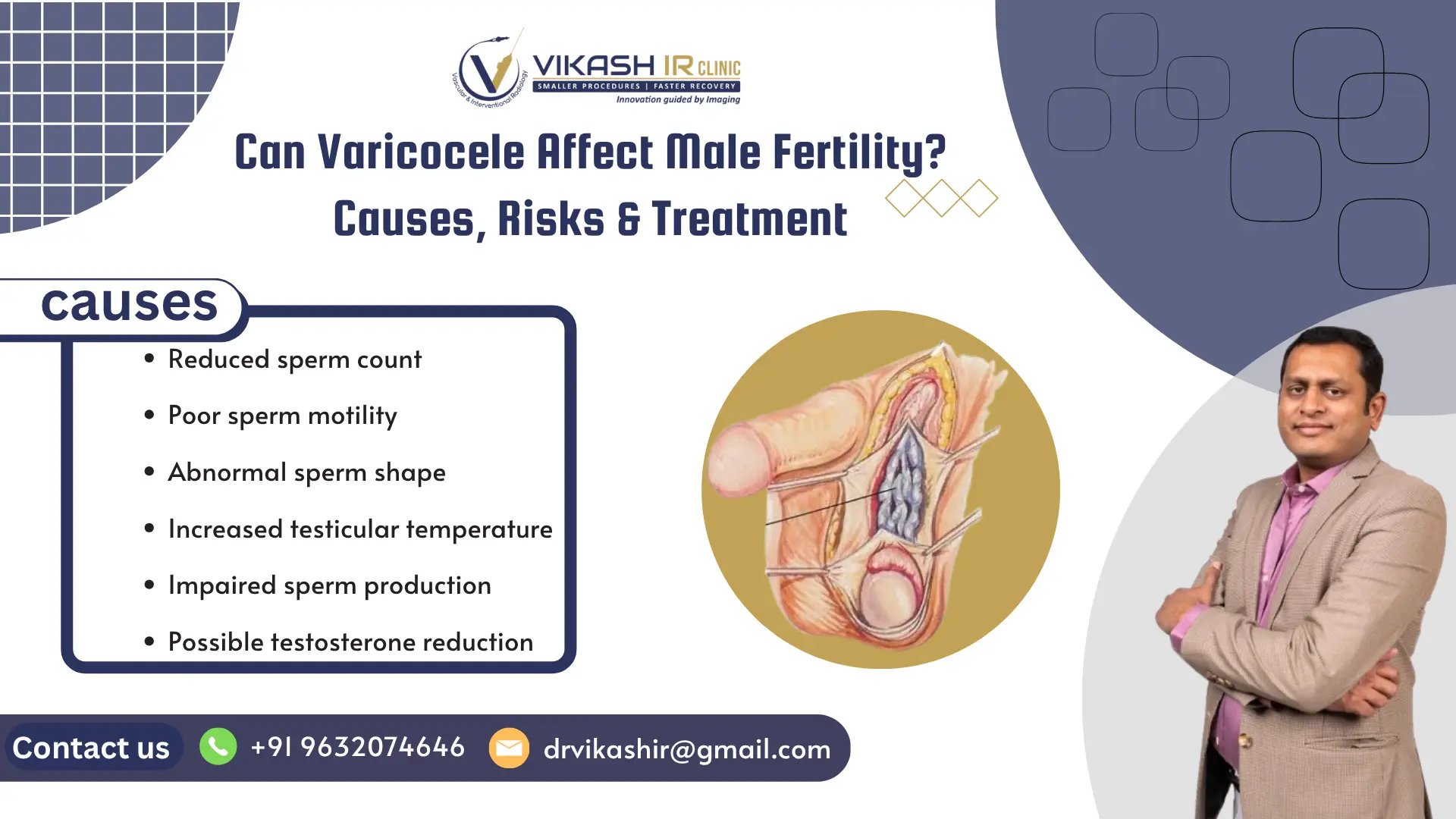
Varicocele Affect Male Fertility is an important concern for men who are trying to conceive. A varicocele is an enlargement of the veins within the scrotum, usually caused by abnormal blood flow. It is common and may cause no symptoms at all, but in some men it can be associated with reduced sperm production, poorer sperm quality, testicular discomfort, or fertility problems.
A varicocele does not automatically mean infertility. Many men with varicoceles can father children without treatment. However, when a clinically significant varicocele is associated with abnormal semen parameters, pain, or testicular changes, medical evaluation may be recommended.
Understanding how Varicocele Affects Male Fertility, when treatment is necessary, and which treatment may be appropriate can help men make informed decisions about their reproductive health.
What Is a Varicocele?
A varicocele is a group of enlarged veins around the testicle. It is similar to varicose veins that can occur in the legs. Varicoceles are more commonly found on the left side because of differences in venous anatomy.
The condition may interfere with normal temperature regulation around the testicles. Changes in blood flow, temperature, and oxidative stress are among the proposed mechanisms through which a varicocele may affect sperm production and quality.
This is why the question Varicocele Affect Male Fertility is particularly relevant for men experiencing difficulty conceiving or abnormal semen-analysis results.
Symptoms, Causes & Risk Factors
Symptoms of Varicocele
Many varicoceles do not cause noticeable symptoms. When symptoms occur, they may include:
- A dull or aching pain in the scrotum
- A feeling of heaviness or dragging
- Discomfort that becomes worse after prolonged standing or physical activity
- Enlarged or twisted veins that may be visible or felt above the testicle
- Testicular size differences or reduced testicular development
- Abnormal semen parameters or fertility concerns
Pain may improve when lying down. Some men discover a varicocele only during a fertility evaluation or routine examination.
Causes of Varicocele
The exact cause of every varicocele is not known. One important factor may be malfunctioning valves within the veins that normally help blood move in the correct direction. When blood flows backward or becomes congested, the veins can enlarge.
The anatomy of the left testicular vein also makes left-sided varicoceles more common.
How Can Varicocele Affect Male Fertility?
Varicocele Affect Male Fertility is usually discussed in relation to sperm production and sperm quality.
A varicocele may contribute to:
- Lower sperm concentration
- Reduced sperm motility
- Abnormal sperm morphology
- Increased oxidative stress
- Changes in testicular function
- Difficulty achieving pregnancy
However, having a varicocele does not necessarily mean it is the cause of infertility. Male fertility can be influenced by several factors, and female fertility factors should also be considered. Varicocele is recognized as one of the most common treatable causes associated with male infertility, although the exact way it affects fertility is not yet fully understood.
When Should Men Seek Medical Evaluation?
Men should consider evaluation if they have a known varicocele along with difficulty conceiving, persistent scrotal pain, abnormal semen results, or concerns about testicular development.
A proper assessment is particularly important before deciding on a procedure because not every varicocele requires treatment.
Diagnosis & Treatment Options
Diagnosis of Varicocele
Diagnosis generally begins with a medical history and physical examination. The doctor may examine the scrotum while the patient is standing and may ask him to perform a Valsalva maneuver to make enlarged veins easier to identify.
A scrotal Doppler ultrasound can provide additional information about the veins and blood flow when clinically appropriate.
For men concerned about fertility, a semen analysis is an important part of the evaluation. Depending on the individual situation, additional fertility or hormonal testing may be recommended.
The AUA/ASRM male infertility guideline emphasizes appropriate specialist evaluation and does not recommend repairing a non-palpable varicocele detected only on imaging.
When Is Treatment Recommended?
Not every varicocele needs treatment. Observation may be appropriate when there are no significant symptoms or fertility-related concerns.
Treatment may be considered when a clinically significant varicocele is associated with infertility and abnormal semen parameters, persistent pain, or other relevant testicular concerns. The decision should be individualized after clinical assessment.
Varicocele Treatment for Men
Varicocele treatment for men may involve either surgical repair or minimally invasive embolization, depending on anatomy, symptoms, fertility goals, previous treatment, and specialist assessment.
Varicocele embolization is a minimally invasive procedure performed by an interventional radiologist. A thin catheter is introduced through a small puncture, commonly through a vein in the neck or groin. Under X-ray guidance, the catheter is directed toward the abnormal veins. Small coils or another embolic material are then used to block abnormal blood flow, allowing blood to reroute through healthier veins.
The procedure is generally performed without a scrotal incision and is often completed on an outpatient basis.
For appropriately selected patients, Varicocele treatment for men through embolization can be an alternative to conventional surgical repair.
Varicocele Embolization Procedure
The procedure generally involves:
- Clinical and imaging evaluation
- Local anesthesia, sometimes with mild sedation
- A tiny puncture in a vein
- Catheter navigation under real-time imaging
- Identification of abnormal venous drainage
- Placement of coils or another embolic agent
- Removal of the catheter and dressing of the puncture site
RadiologyInfo states that the procedure is usually completed within about an hour, although actual duration can vary according to individual anatomy and procedural complexity.
Benefits of Varicocele Embolization
Potential benefits include:
- No scrotal surgical incision
- No stitches at the treatment site
- Minimally invasive approach
- Usually short recovery
- Ability to target abnormal venous blood flow
- Potential improvement in pain and sperm parameters in appropriate patients
Current evidence does not establish one repair technique as universally superior for fertility outcomes. Treatment should therefore be selected according to the patient’s clinical circumstances and specialist assessment.
Recovery, Comparison & FAQs
Recovery After Varicocele Embolization
Recovery after embolization is generally shorter than recovery from conventional surgery. Patients may experience mild discomfort or localized swelling for several days. RadiologyInfo notes that many patients can resume normal activities within approximately 24 hours, although strenuous activity may need to be avoided for a short period based on the doctor’s instructions.
Fertility improvement, when it occurs, is not immediate. Sperm production takes time, so follow-up semen analysis may be recommended after an appropriate interval.
Embolization vs Surgical Varicocele Repair
Both embolization and surgery aim to stop abnormal blood flow through the affected veins.
Embolization is performed through a catheter and avoids a scrotal incision. It may offer faster recovery and less postoperative discomfort for suitable patients.
Surgical repair, or varicocelectomy, involves directly ligating the affected veins. Different surgical techniques are available.
Neither approach is automatically the best choice for every patient. The appropriate option depends on venous anatomy, fertility status, symptoms, previous procedures, and the expertise available.
Can Varicocele Affect Male Fertility Permanently?
Varicocele Affect Male Fertility does not necessarily mean permanent infertility. Some men with varicocele have normal fertility. When a varicocele contributes to abnormal sperm production, appropriate treatment may improve semen parameters in selected patients, although improvement cannot be guaranteed.
Frequently Asked Questions
1. Can Varicocele Affect Male Fertility?
Yes. A clinically significant varicocele may be associated with reduced sperm production or poorer sperm quality. However, not every man with a varicocele will experience infertility.
2. Does every varicocele require treatment?
No. Many varicoceles do not require treatment. Management depends on symptoms, fertility concerns, semen results, testicular changes, and clinical findings.
3. Can a varicocele cause low sperm count?
Yes. Varicoceles can be associated with lower sperm quantity and quality in some men. A semen analysis helps determine whether sperm parameters are abnormal.
4. What is the best Varicocele treatment for men?
There is no single treatment that is best for everyone. Surgical repair and catheter-based embolization are established treatment approaches, and the appropriate option depends on individual circumstances.
5. Is varicocele embolization a surgery?
No. Varicocele embolization is a minimally invasive, image-guided procedure performed through a small venous puncture rather than a conventional surgical incision.
6. How long does varicocele embolization take?
The procedure commonly takes around an hour, although duration can vary depending on anatomy and technical factors.
7. How soon can I return to normal activities?
Many patients can return to routine activities relatively quickly after embolization. Individual instructions vary, particularly regarding exercise and strenuous activity.
8. Can treating a varicocele improve fertility?
Treatment may improve semen parameters in appropriately selected men, but fertility outcomes vary. A fertility evaluation should consider both partners and other potential causes of infertility.
9. Can a varicocele come back after treatment?
Recurrence or persistence is possible after varicocele treatment. Follow-up is important if symptoms continue or fertility parameters do not improve.
10. Should I get a semen analysis if I have a varicocele?
If fertility is a concern, semen analysis is commonly used to assess sperm concentration, motility, and morphology. Your doctor can determine whether additional tests are appropriate.
Dr. Vikash Chennur and Varicocele Treatment
For men seeking Varicocele treatment for men in Bengaluru, Dr. Vikash Chennur | AIIMS Gold Medalist | Best Endovascular Interventional Radiologist provides image-guided, minimally invasive interventional radiology care. His listed services include Varicocele Embolization, Uterine Fibroid Embolization, Thyroid Nodule Ablation, Prostate Artery Embolization, Varicose Vein Treatment, Fibroadenoma Treatment, Interventional Pain Management, liver cancer ablation, TACE, and other image-guided procedures.
I offer the varicocele service that focuses on careful imaging-based evaluation and patient selection before recommending embolization.
Conclusion
Varicocele Affect Male Fertility is an important question, but having a varicocele does not automatically mean that a man is infertile. The condition can be associated with impaired sperm production, abnormal semen parameters, testicular discomfort, and fertility difficulties in some patients.
Diagnosis should be based on clinical evaluation, appropriate imaging, and semen analysis when fertility is a concern. Treatment is not necessary for every varicocele. When intervention is appropriate, both surgical repair and minimally invasive embolization may be considered.
If you have a varicocele, abnormal semen results, scrotal discomfort, or difficulty conceiving, consult an experienced specialist for an individualized evaluation.
Book an appointment with Dr. Vikash Chennur | AIIMS Gold Medalist | Best Endovascular Interventional Radiologist to discuss Varicocele treatment for men, including minimally invasive Varicocele Embolization, and understand whether this treatment is suitable for you.