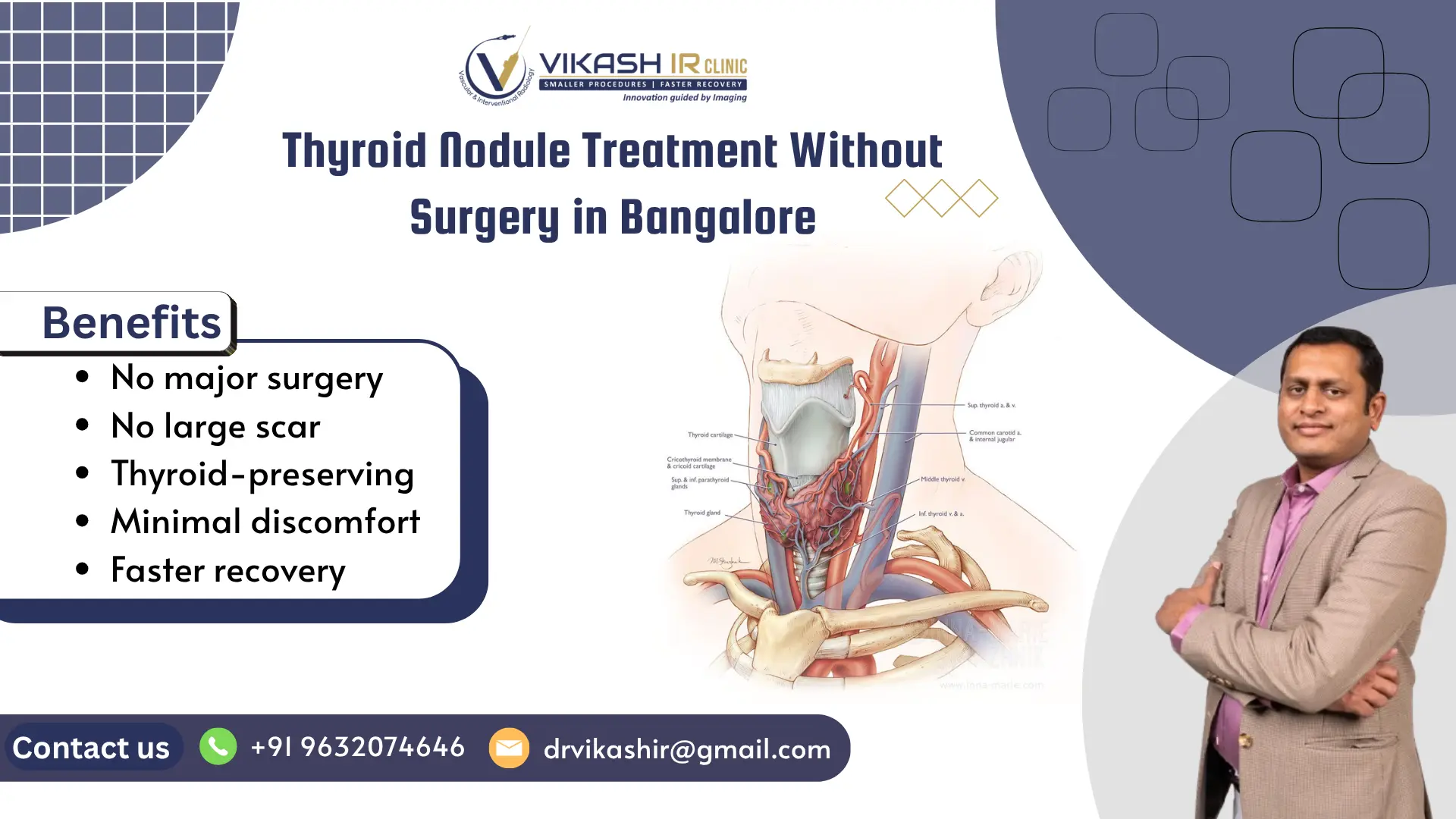
A thyroid nodule is a lump that develops within the thyroid gland. Many thyroid nodules are benign and may not require immediate treatment. However, a nodule that becomes large, causes pressure symptoms, creates a visible neck swelling, or produces excess thyroid hormone may require active management. For appropriately selected patients, Thyroid Nodule Treatment Without Surgery can provide a minimally invasive alternative to conventional surgery.
Modern image-guided techniques such as radiofrequency ablation (RFA) can reduce the volume of selected benign thyroid nodules while preserving most of the surrounding thyroid tissue. The American Thyroid Association recognizes thermal ablation as an alternative treatment strategy for a subset of patients with symptomatic benign thyroid nodules, provided appropriate patient and nodule selection is performed.
For patients looking for Thyroid Nodule Treatment Without Surgery in Bangalore, evaluation by an experienced interventional radiologist can help determine whether thyroid nodule ablation is appropriate.
Understanding Thyroid Nodules: Symptoms and Causes
What is a thyroid nodule?
A thyroid nodule is a localized growth or abnormal area within the thyroid gland. Nodules may be solid, cystic, or mixed. Some are discovered during a routine examination, while others are detected incidentally during an ultrasound or other imaging examination.
Most thyroid nodules are not cancerous. However, every newly identified nodule should be evaluated carefully before treatment is selected. A benign diagnosis is particularly important when considering Thyroid Nodule Treatment Without Surgery, because ablation is generally intended for appropriately selected benign nodules.
Symptoms of thyroid nodules
Small thyroid nodules may produce no symptoms. Larger nodules can cause:
- A visible lump or swelling in the neck
- A feeling of pressure or fullness in the throat
- Difficulty swallowing
- Discomfort while wearing tight collars
- A sensation of something pressing in the neck
- Cosmetic concerns because of a visible swelling
- Hoarseness or voice changes in some cases
- Symptoms of excess thyroid hormone when the nodule is functioning
Not every symptom is caused by the thyroid nodule itself. A detailed clinical assessment and imaging are therefore important before deciding on treatment.
Causes and risk factors
The exact cause of an individual thyroid nodule may not always be identifiable. Nodules can occur in people with otherwise normal thyroid function. Some may develop in association with multinodular thyroid disease, thyroid inflammation, iodine-related factors, or changes within thyroid tissue.
Age, previous radiation exposure to the neck, family history of thyroid cancer, and certain clinical characteristics can influence the assessment of malignancy risk.
Importantly, Thyroid Nodule Treatment Without Surgery should not be considered simply because a nodule is present. The treatment decision depends on the nodule’s ultrasound characteristics, biopsy findings, symptoms, size, thyroid function, and the patient’s overall clinical situation.
Diagnosis and Thyroid Nodule Ablation Procedure
How are thyroid nodules diagnosed?
Diagnosis generally begins with a clinical examination followed by thyroid ultrasound. Ultrasound helps determine the nodule’s size, composition, margins, internal characteristics, and relationship with important structures in the neck.
Blood tests, including thyroid-stimulating hormone (TSH), may also be recommended to assess thyroid function. Depending on the ultrasound appearance and clinical risk, fine-needle aspiration (FNA) or another biopsy may be advised.
The American Thyroid Association notes that suspicious or cancerous thyroid nodules require appropriate surgical management, while benign nodules may be monitored or treated depending on their characteristics and symptoms.
Who may be suitable for ablation?
Thyroid Nodule Ablation is generally considered for selected patients with benign nodules that are symptomatic or causing cosmetic concerns. The ATA consensus statement emphasizes careful patient and nodule selection before thermal ablation.
Depending on the individual case, an appropriate candidate may have:
- A benign thyroid nodule confirmed through appropriate cytology or biopsy
- A nodule causing pressure, swallowing, or cosmetic symptoms
- A dominant nodule responsible for the patient’s complaints
- A suitable ultrasound appearance
- Realistic expectations regarding the outcome of treatment
Not every thyroid nodule is suitable for ablation. Suspicion of malignancy, certain anatomical locations, significant substernal extension, and other clinical factors may make another treatment approach more appropriate.
How does thyroid nodule ablation work?
Radiofrequency ablation is an image-guided procedure. After local anesthesia, a specialized electrode is carefully positioned into the thyroid nodule under ultrasound guidance. Radiofrequency energy generates controlled heat within targeted tissue, leading to destruction of the treated portion of the nodule.
The body gradually absorbs the treated tissue, resulting in reduction in nodule volume over time. RFA is therefore different from surgery: the thyroid gland is not removed, and there is no conventional surgical incision.
Thermal ablation technologies also include laser ablation and microwave ablation. The appropriate technique depends on the nodule, its location, clinical objectives, and the expertise available.
Why choose a minimally invasive approach?
For selected patients, Minimally Invasive Thyroid Nodule Treatment can reduce the need for conventional surgery while targeting the symptomatic nodule. The procedure is performed under image guidance, allowing the treating specialist to monitor the treatment area and protect nearby structures.
However, ablation is not automatically better than surgery for every patient. Proper diagnosis and patient selection remain essential.
Benefits, Recovery and Comparison With Surgery
Benefits of Thyroid Nodule Treatment Without Surgery
For suitable patients, Thyroid Nodule Treatment Without Surgery may offer several potential advantages:
- No conventional surgical incision
- Local anesthesia in many cases
- Preservation of much of the thyroid gland
- Reduced disruption to surrounding tissues
- Treatment focused on the problematic nodule
- Potential improvement in pressure or cosmetic symptoms
- Generally shorter recovery compared with conventional thyroid surgery
Published consensus guidance reports that thermal ablation can produce substantial volume reduction in appropriately selected benign nodules, while emphasizing that the technique still carries potential risks and requires appropriate expertise.
Recovery after thyroid nodule ablation
Recovery varies according to the nodule, treatment technique, and individual health. Many patients can return to routine activities relatively quickly, although temporary neck discomfort, tenderness, or mild swelling can occur.
Follow-up is important because the objective is usually gradual reduction in nodule volume rather than immediate disappearance. Ultrasound examinations can be used to assess changes in size and treatment response.
Patients should promptly report significant pain, increasing swelling, difficulty breathing, difficulty swallowing, or voice changes after a procedure.
Thyroid ablation vs thyroid surgery
| Feature | Thyroid Nodule Ablation | Thyroid Surgery |
| Approach | Image-guided, minimally invasive | Conventional operation |
| Thyroid tissue | Usually preserved | Part or all may be removed |
| Incision | No conventional surgical incision | Surgical incision |
| Anesthesia | Often local anesthesia | Usually general anesthesia |
| Recovery | Generally shorter | Usually longer |
| Histopathology | Does not provide a surgical specimen | Provides removed tissue for pathology |
| Best suited for | Selected benign symptomatic nodules | Cancer, suspicious nodules, or selected large/complex cases |
This comparison does not mean ablation is suitable for everyone. In particular, a nodule that is cancerous or highly suspicious for cancer generally requires appropriate oncological evaluation and, when indicated, surgery.
Why expert evaluation matters
Because the thyroid lies close to the voice nerves, airway, esophagus, blood vessels, and other sensitive structures, thyroid ablation requires detailed ultrasound assessment and technical expertise. The American Thyroid Association specifically highlights the importance of procedural training, safety measures, patient selection, and post-procedure follow-up.
For patients considering Thyroid Nodule Treatment Without Surgery in Bangalore, Dr Vikash Chennur provides image-guided interventional radiology evaluation and minimally invasive treatment options. He is an AIIMS Gold Medalist and Endovascular Interventional Radiologist, with expertise in image-guided procedures.
Frequently Asked Questions
1. Can every thyroid nodule be treated without surgery?
No. Thyroid Nodule Treatment Without Surgery is primarily considered for appropriately selected benign nodules. Suspicious or confirmed malignant nodules require a different treatment pathway.
2. What is thyroid nodule ablation?
Thyroid Nodule Ablation is a minimally invasive procedure that uses controlled energy, such as radiofrequency energy, to destroy targeted thyroid nodule tissue. The treated tissue gradually shrinks over time.
3. Is thyroid RFA painful?
The procedure is performed with local anesthesia to minimize discomfort. Some patients may experience pressure, warmth, or temporary discomfort during or after treatment.
4. Will the thyroid gland be removed?
No. One of the main differences between ablation and thyroid surgery is that ablation targets the nodule while preserving the thyroid gland.
5. How long does it take for a thyroid nodule to shrink?
Reduction occurs gradually. Follow-up ultrasound examinations are used to monitor the response and determine how much the nodule has reduced.
6. Is a biopsy required before ablation?
In many appropriate cases, confirmation that the nodule is benign is an important part of treatment planning. The exact biopsy requirement depends on the ultrasound findings and clinical circumstances. ATA guidance emphasizes establishing a firm conviction of benignity before thermal ablation.
7. Can thyroid function remain normal after ablation?
Because the procedure targets a specific nodule rather than removing the entire thyroid, thyroid tissue is generally preserved. However, thyroid function varies between patients, so appropriate blood-test monitoring may be recommended.
8. Is thyroid ablation better than surgery?
Neither treatment is universally better. Thyroid Nodule Treatment Without Surgery may be a suitable option for selected benign symptomatic nodules, whereas surgery remains important for many suspicious, malignant, very large, or anatomically complex conditions.
9. Can a thyroid nodule come back after ablation?
The treated portion of a nodule may shrink substantially, but residual or untreated tissue can remain. Some nodules may show regrowth or require additional treatment, which is why long-term ultrasound follow-up is important.
10. Where can I get thyroid nodule ablation in Bangalore?
Patients looking for Thyroid Nodule Treatment Without Surgery in Bangalore can consult Dr Vikash Chennur | AIIMS Gold Medalist | Best Endovascular Interventional Radiologist for evaluation of thyroid nodules and suitability for image-guided minimally invasive treatment.
Conclusion
Thyroid Nodule Treatment Without Surgery has become an important minimally invasive option for carefully selected patients with benign, symptomatic thyroid nodules. Radiofrequency ablation and other image-guided techniques can target the abnormal tissue while preserving much of the normal thyroid gland.
The most important step is not simply choosing an ablation procedure but confirming that the patient and nodule are appropriate candidates. Ultrasound assessment, thyroid function testing, appropriate biopsy, risk evaluation, and specialist consultation should guide the treatment decision.
If you are experiencing a thyroid lump, neck pressure, swallowing discomfort, or cosmetic concerns, do not assume that surgery is your only option. A specialist assessment can help determine whether Thyroid Nodule Treatment Without Surgery is appropriate for your condition.
Book an appointment with Dr Vikash Chennur | AIIMS Gold Medalist | Best Endovascular Interventional Radiologist in Bangalore to discuss thyroid nodule evaluation, Thyroid Nodule Ablation, and other Minimally Invasive Thyroid Nodule Treatment options. Get an individualized treatment plan based on your ultrasound findings, biopsy results, symptoms, and overall health.