
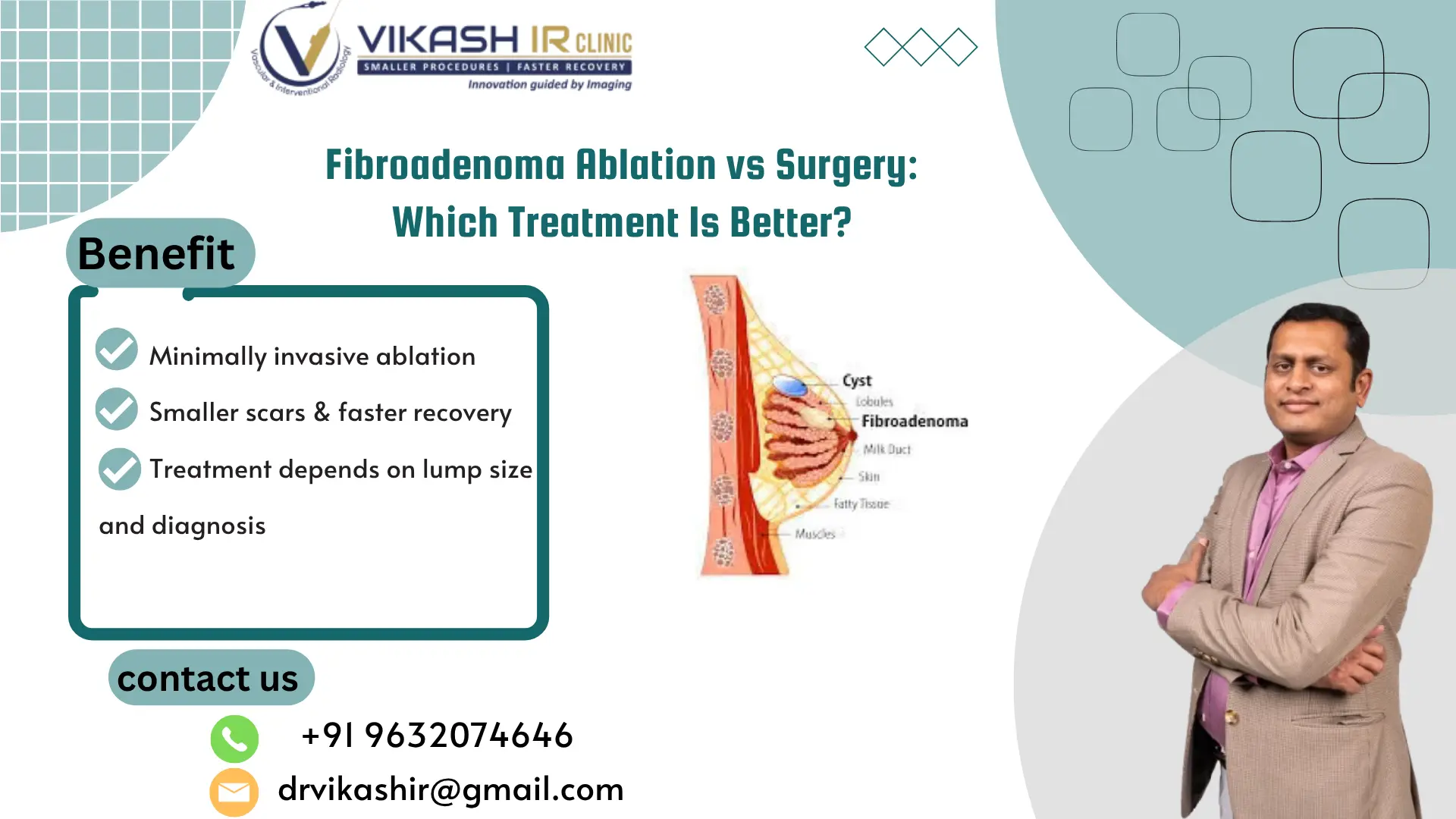
A fibroadenoma is a common, non-cancerous breast lump that often occurs in younger women. Although it is usually benign, discovering a breast lump can cause anxiety and raise questions about the safest and most appropriate treatment. Depending on the lump’s size, symptoms, imaging findings, and biopsy results, management may involve observation, minimally invasive treatment, or surgical removal.
Fibroadenoma Treatment Without Surgery may be an option for selected patients who want to avoid an operation. One minimally invasive approach is fibroadenoma ablation, which uses energy to destroy targeted tissue without removing the entire lump through a surgical incision. However, not every fibroadenoma is suitable for ablation, and the diagnosis must be confirmed before treatment decisions are made.
If you are comparing fibroadenoma ablation with surgery in Bengaluru, understanding the differences can help you discuss your options with an appropriately qualified specialist.
Introduction: What Is a Fibroadenoma?
A fibroadenoma is a benign breast tumour made up of glandular and connective tissue. It often feels like a smooth, firm, rubbery lump that moves slightly under the skin. Fibroadenomas are particularly common in younger women, although they can occur at different ages.
Most fibroadenomas do not become cancerous. However, a new or changing breast lump should always be assessed by a qualified medical professional rather than assumed to be benign.
The most appropriate treatment depends on the clinical examination, ultrasound or other breast imaging, and, when indicated, a tissue sample obtained through a biopsy. Some fibroadenomas require only periodic monitoring, while others may need removal or another suitable intervention.
Fibroadenoma Ablation vs Surgery: Which Treatment Is Better? There is no single answer for every patient. Ablation may suit selected, confirmed benign lumps, whereas surgery may be preferable when a lump is large, growing, symptomatic, diagnostically uncertain, or unsuitable for an ablation technique.
Symptoms, Causes, and Diagnosis of Fibroadenoma
Common Symptoms of Fibroadenoma
Fibroadenomas often do not cause pain. Many women discover them during self-examination, a routine clinical check-up, or breast imaging. Common features include:
- A smooth, firm or rubbery breast lump.
- A lump that moves slightly under the skin.
- A round or oval shape with clearly defined edges.
- Little or no pain or tenderness.
- Changes in lump size over time, sometimes associated with hormonal fluctuations.
A rapidly growing lump, a new lump after menopause, skin dimpling, nipple changes, or unusual nipple discharge requires prompt medical evaluation. These signs do not automatically indicate cancer, but they should not be ignored.
What Causes Fibroadenoma?
The exact cause of fibroadenoma is not fully understood. Hormonal influences, particularly oestrogen, are thought to contribute to its development. Fibroadenomas are more common during reproductive years and may change in size with hormonal variations.
Having a fibroadenoma does not mean that a woman has breast cancer. Nevertheless, appropriate assessment is necessary to distinguish a fibroadenoma from other breast conditions.
How Is Fibroadenoma Diagnosed?
Before considering Fibroadenoma Treatment Without Surgery, a specialist must establish whether the lump is genuinely benign.
The diagnostic process may include:
- Clinical breast examination: The doctor assesses the lump’s size, consistency, mobility, and location.
- Ultrasound: Breast ultrasound helps evaluate the lump’s structure and characteristics, particularly in younger women.
- Mammography: Depending on the patient’s age and clinical findings, mammography may be recommended.
- FNAC or core needle biopsy: Fine-needle aspiration cytology (FNAC) collects cells for examination, while a core needle biopsy obtains a small tissue sample. A core biopsy may provide more definitive information about tissue architecture.
The choice of tests depends on the patient’s age, imaging findings, and clinical assessment. If examination, imaging, and pathology results do not agree, further investigation or surgical removal may be necessary.
Treatment Options: Fibroadenoma Ablation vs Surgery
Treatment depends on the lump’s size, growth pattern, symptoms, diagnostic certainty, cosmetic considerations, and the patient’s preferences. Not every fibroadenoma needs an intervention. Small, stable, confirmed benign fibroadenomas may be monitored through clinical and imaging follow-up.
1. Fibroadenoma Ablation
Fibroadenoma ablation is a minimally invasive approach intended to destroy targeted tissue rather than remove the lump through conventional surgery. Depending on the technique and local availability, it may involve image-guided radiofrequency ablation (RFA), laser ablation, or another appropriate thermal technique.
During an ablation procedure, imaging guidance helps the treating specialist position the device accurately. The selected energy source heats the target tissue, causing it to undergo gradual breakdown and shrinkage over time.
Important considerations include:
- Patient selection: Ablation is generally considered only when the diagnosis is sufficiently established as benign and the lump is suitable for the proposed technique.
- Imaging guidance: Ultrasound or other appropriate imaging helps the specialist target the lesion and monitor the procedure.
- Tissue confirmation: A suitable biopsy assessment is important before ablation. Ablation destroys tissue, so it does not provide the same complete surgical specimen for pathological examination.
- Follow-up: The lump may shrink gradually rather than disappear immediately. Clinical review and follow-up imaging are important.
Ablation may offer a less invasive alternative for selected patients, but availability, evidence, suitability, and outcomes vary by technique and individual circumstances.
2. Surgical Removal of Fibroadenoma
Surgical excision involves removing the fibroadenoma through an incision in the breast. It is an established treatment option and may be recommended when a lump is large, growing, painful, cosmetically concerning, or associated with uncertain diagnostic findings.
Surgery may also be preferred when the specialist needs the entire lump for detailed pathological examination or when ablation is not appropriate.
Potential considerations include an incision, scar formation, post-procedure discomfort, anaesthesia requirements, and recovery time. The extent of these effects varies according to the lump’s location, size, and the surgical technique used.
3. Benefits and Limitations of Each Treatment
Potential benefits of fibroadenoma ablation
- Usually requires only a small needle or probe entry rather than a conventional surgical incision.
- May reduce visible scarring.
- Can preserve surrounding breast tissue when appropriately performed.
- May allow a relatively quick return to everyday activities.
- May be suitable for selected patients seeking a minimally invasive approach.
However, ablation does not provide a complete excised specimen, and the lump may take time to shrink. Some patients may need additional evaluation or treatment.
Potential benefits of surgery
- Remove the lump directly.
- Provides tissue for comprehensive pathological examination.
- Is an established option for larger or diagnostically uncertain lesions.
- May be more appropriate when complete removal is the clinical priority.
Surgery can involve a longer recovery period and a visible scar. As with any procedure, bleeding, infection, changes in breast contour, and other complications are possible.
4. Recovery After Ablation or Surgery
Recovery depends on the procedure performed, the patient’s general health, and the size and location of the fibroadenoma.
After ablation, some patients experience temporary soreness, swelling, or bruising. Many can resume light activities relatively soon, subject to their treating specialist’s instructions. Follow-up imaging may be needed to assess the response over time.
After surgery, patients may experience wound discomfort, swelling, bruising, and temporary restrictions on lifting or strenuous activity. Recovery may take longer, depending on the operation and individual healing.
Neither approach guarantees that a new fibroadenoma will never develop elsewhere in the breast. Follow-up care remains important after either treatment.
5. Fibroadenoma Ablation vs Surgery: Which Treatment Is Better?
The comparison below can help you understand the main differences.
| Factor | Ablation | Surgery |
| Approach | Minimally invasive, image-guided treatment | Surgical removal through an incision |
| Tissue removal | Targeted tissue is destroyed | The lump is removed |
| Scar | Often minimal | A surgical scar may remain |
| Recovery | May be shorter in suitable cases | May require more recovery time |
| Pathology | Does not provide a complete excised specimen | Provides removed tissue for examination |
| Suitable cases | Selected, confirmed benign lumps | Benign lumps requiring removal or further diagnostic assessment |
There is no universal winner in the Fibroadenoma Ablation vs Surgery: Which Treatment Is Better? decision. Ablation may be appropriate when the diagnosis is secure and the lesion is suitable. Surgery may be the better choice when complete excision or comprehensive pathological assessment is required.
Cost also varies according to the technique, investigations, facility, anaesthesia, and follow-up requirements. An individual treatment estimate should be obtained after clinical assessment rather than relying on a general online price.
6. Is Embolisation Used for Fibroadenoma?
Embolisation involves blocking selected blood vessels and is used for certain medical conditions. It is not a routine, established first-line treatment for a typical breast fibroadenoma. It should not be presented as interchangeable with RFA or laser ablation.
The appropriate procedure must be chosen according to accepted clinical evidence, the confirmed diagnosis, and the treating specialist’s expertise.
Frequently Asked Questions (FAQs), Conclusion, and Appointment
Frequently Asked Questions
1. What is the best treatment for fibroadenoma?
The best treatment depends on the lump’s size, symptoms, growth, and biopsy findings. Monitoring, ablation, or surgical removal may be appropriate in different circumstances.
2. Is Fibroadenoma Treatment Without Surgery Possible?
Yes. Selected patients with confirmed benign fibroadenomas may be considered for minimally invasive ablation. Others may need observation or surgery, depending on their clinical findings.
3. Is fibroadenoma ablation safe?
Ablation may be an option for appropriately selected patients when performed by a qualified specialist. As with any procedure, risks and limitations should be discussed beforehand.
4. Is RFA better than surgery for fibroadenoma?
Radiofrequency ablation may offer advantages in selected cases, including a smaller entry point and potentially quicker recovery. Surgery remains preferable in some cases, especially when complete tissue examination is needed.
5. Is a biopsy necessary before fibroadenoma ablation?
A reliable diagnosis is essential before ablation. A core needle biopsy or another appropriate diagnostic test may be recommended based on imaging and clinical findings.
6. Can fibroadenoma disappear without treatment?
Some fibroadenomas remain stable, while others shrink over time. A clinician should determine whether monitoring is appropriate and advise on follow-up.
7. Does fibroadenoma surgery leave a scar?
Surgery generally involves an incision and may leave a scar. Its visibility depends on the incision location, healing, and surgical technique.
8. How long does recovery take after fibroadenoma ablation?
Recovery varies by technique and individual circumstances. Some patients resume normal activities relatively quickly, but the treating specialist should provide personalized instructions.
9. Where can I consult a specialist for fibroadenoma treatment in Bengaluru?
Patients can seek an assessment with Dr Vikash Chennur in J. P. Nagar, Bengaluru, to discuss the diagnostic findings and determine whether a minimally invasive approach is appropriate.
10. Fibroadenoma Ablation vs Surgery: Which Treatment Is Better for Me?
The answer depends on your diagnosis, symptoms, lump characteristics, and personal preferences. A specialist can review your imaging and biopsy results before recommending an appropriate treatment plan.
Conclusion
Fibroadenoma Ablation vs Surgery: Which Treatment Is Better? is a decision that should be based on accurate diagnosis and individual clinical needs rather than the assumption that one method suits everyone.
For selected patients, ablation may offer a minimally invasive alternative with limited scarring. Surgery remains an established option when complete removal or more extensive pathological assessment is necessary. In other cases, monitoring may be sufficient.
If you have a breast lump, arrange an appropriate clinical evaluation before choosing a treatment. Discuss the expected benefits, risks, limitations, recovery, follow-up, and cost of each suitable option with your treating specialist.
Book a Consultation with Dr Vikash Chennur
Dr Vikash Chennur
AIIMS Gold Medalist | Best Endovascular Interventional Radiologist
Consult to discuss your diagnostic findings and whether a suitable minimally invasive treatment option is available for your condition.
Phone: +919632074646
Email: drvikashir@gmail.com
Address: 1st Floor, 15, Bannerghatta Road, Sarakki Industrial Layout, 3rd Phase, J. P. Nagar, Bengaluru, Karnataka 560078.