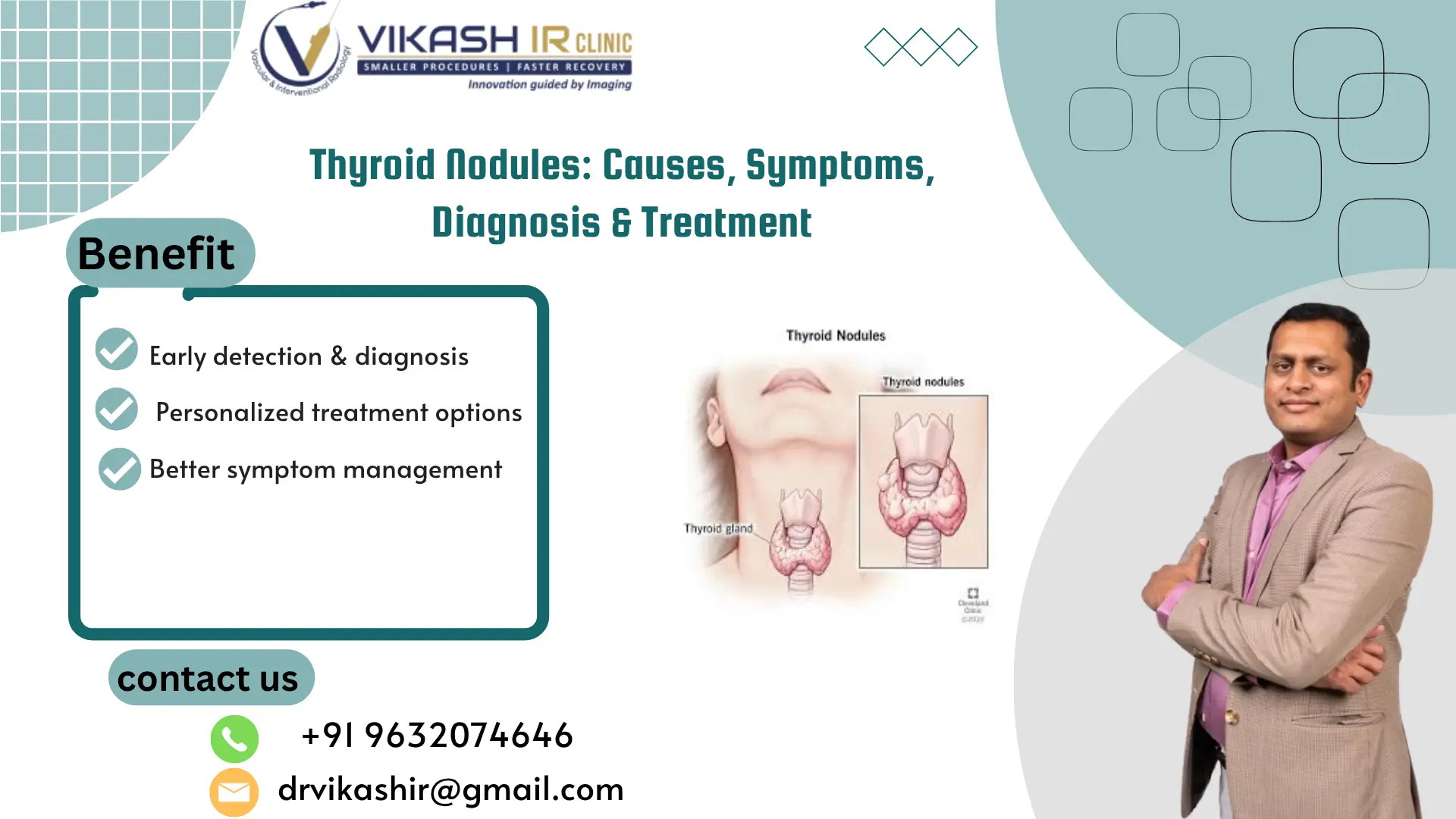
Thyroid nodules are common lumps or growths that develop within the thyroid gland, located at the front of the neck. Many thyroid nodules are benign, meaning they are not cancerous, and may not cause any symptoms. However, some nodules can become large enough to cause neck pressure, swallowing difficulties, visible swelling, or other symptoms. A small proportion may require evaluation for thyroid cancer.
Thyroid Nodules: Causes, Symptoms, Diagnosis & Treatment can vary considerably from one patient to another. Some nodules only need observation, while others may require biopsy, medication, surgery, radioactive iodine, or minimally invasive treatment such as thyroid nodule RFA.
If you have recently discovered a thyroid lump or nodule, the first step is not to assume that it requires treatment. Proper evaluation with clinical examination, thyroid blood tests and ultrasound helps determine what should happen next.
For patients in Bengaluru, consultation with an experienced interventional radiologist can help determine whether a minimally invasive approach is appropriate.
Thyroid Nodules: Causes and Symptoms
What causes thyroid nodules?
There is no single cause of every thyroid nodule. Nodules can develop because of changes in thyroid tissue, inflammation, iodine-related factors, cystic changes or other thyroid conditions. Some people may have one nodule, while others develop multiple nodules.
Most thyroid nodules are benign. However, because a small percentage can be cancerous, the discovery of a nodule should be evaluated rather than ignored.
Common symptoms of thyroid nodules
Many thyroid nodules are discovered incidentally during a routine examination or imaging test because they do not produce noticeable symptoms.
When symptoms occur, they may include:
- A lump or swelling in the front of the neck
- A feeling of pressure or fullness in the neck
- Difficulty swallowing
- A sensation of something pressing on the throat
- Hoarseness or voice changes
- Neck discomfort
- Difficulty breathing when a large nodule compresses nearby structures
- Cosmetic concerns because of a visible neck swelling
Some thyroid nodules can produce excess thyroid hormone. These are known as autonomously functioning or toxic nodules and may be associated with symptoms such as palpitations, tremors, anxiety, heat intolerance or unexplained weight loss.
Thyroid Nodules: Causes, Symptoms & Treatment should therefore be understood as an individualised process. A nodule that causes no symptoms may only require monitoring, whereas a growing or symptomatic nodule may require further intervention.
When should you see a doctor?
You should seek medical evaluation if you notice a new neck lump, increasing swelling, persistent swallowing difficulty, voice changes or pressure symptoms. A rapidly changing neck swelling also deserves prompt medical assessment.
Having a thyroid nodule does not automatically mean that you have thyroid cancer. The purpose of diagnostic testing is to determine the nature and risk level of the nodule.
Thyroid Nodules: Diagnosis and Evaluation
Thyroid ultrasound
Ultrasound is one of the most important tests for evaluating thyroid nodules. It can show the nodule’s size, composition, margins, shape, echogenicity and other characteristics.
The ACR TI-RADS system uses ultrasound features to categorise thyroid nodules according to their level of suspicion and helps determine whether biopsy or follow-up imaging may be appropriate.
Thyroid blood tests
A doctor may recommend blood tests such as TSH and, when appropriate, other thyroid hormone tests. These tests help determine whether the thyroid is functioning normally or whether the nodule may be associated with excess thyroid hormone.
Importantly, normal thyroid blood tests do not by themselves rule out the presence of a thyroid nodule or determine whether a nodule is benign.
Fine-needle aspiration biopsy
When imaging findings and nodule size indicate that tissue evaluation is appropriate, a fine-needle aspiration (FNA/FNAC) may be recommended. A thin needle is used to collect cells from the nodule for laboratory examination.
The results can help doctors determine whether the nodule is benign, suspicious, malignant or requires further assessment.
Understanding the diagnosis before treatment
Treatment should not be selected simply because a nodule is present. The decision depends on factors such as:
- Ultrasound characteristics
- Cytology or biopsy findings
- Nodule size
- Growth over time
- Symptoms
- Cosmetic concerns
- Thyroid function
- Patient preferences
- Overall health
- Whether the nodule is suitable for a particular procedure
This evaluation is particularly important before considering Thyroid Nodule RFA, because RFA is primarily used for appropriately selected benign nodules rather than as a replacement for cancer diagnosis.
Thyroid Nodules: Treatment Options, RFA and Recovery
When is treatment necessary?
Not every thyroid nodule requires immediate treatment. Small, asymptomatic benign nodules may simply be monitored with periodic clinical assessment and ultrasound.
Treatment may be considered when a benign nodule is large, growing, causes pressure or swallowing symptoms, produces cosmetic concerns, or is functioning abnormally. The appropriate treatment depends on the patient’s individual clinical situation.
What is the Thyroid Nodule RFA?
Thyroid Nodule RFA, or radiofrequency ablation, is a minimally invasive technique that uses radiofrequency energy to generate controlled heat within a selected thyroid nodule. A thin electrode is placed into the nodule under ultrasound guidance, allowing the targeted tissue to be treated while limiting damage to surrounding structures.
The treated nodule gradually decreases in volume rather than being surgically removed. The American Thyroid Association recognises thermal ablation as a non-surgical treatment approach for appropriately selected benign thyroid nodules and emphasises the importance of appropriate training and patient selection.
Who may be considered for RFA?
RFA may be considered for selected patients with benign thyroid nodules that:
- Cause compressive or local symptoms
- Create cosmetic concerns
- Are sufficiently large or have demonstrated growth
- Are appropriate for ablation based on imaging and clinical assessment
- Have been adequately evaluated to establish that RFA is appropriate
The exact eligibility varies according to the individual case.
Non-Surgical Thyroid Nodule Treatment can be particularly relevant for patients who want to explore options other than conventional surgery. However, “non-surgical” does not mean that RFA is suitable for every nodule. Proper diagnostic evaluation remains essential.
RFA compared with conventional surgery
| Feature | Thyroid Nodule RFA | Conventional Thyroid Surgery |
| Approach | Minimally invasive | Surgical |
| Nodule | Treated in place | Removed surgically |
| Incision | Small needle entry | Surgical incision |
| Thyroid tissue | Can preserve more normal thyroid tissue | May involve removal of part or all of the thyroid |
| Anaesthesia | Depends on case and clinical protocol | Usually requires anaesthesia |
| Recovery | Generally shorter for appropriately selected patients | Usually longer |
| Suitability | Selected benign nodules | Various indications, including suspicious or malignant disease |
RFA is not a universal substitute for surgery. Suspicious or confirmed malignant nodules generally require cancer-directed management, and some benign nodules may also be better treated surgically depending on their size, location, symptoms and other characteristics.
Benefits of RFA
Potential advantages for appropriately selected patients include:
- Minimally invasive treatment
- No conventional surgical incision
- Reduction in nodule volume over time
- Potential improvement in pressure-related or cosmetic symptoms
- Preservation of surrounding thyroid tissue
- Generally limited recovery compared with conventional surgery
Long-term evidence also indicates that RFA can provide substantial volume reduction in appropriately selected benign nodules, although some nodules can regrow and follow-up remains important.
Recovery and follow-up
Recovery depends on the individual procedure and the patient’s health. Some patients can return to routine activities relatively quickly, but the treating doctor will provide specific instructions regarding activity, medication and follow-up.
RFA does not make follow-up unnecessary. Ultrasound monitoring is important to assess the treated nodule’s response and identify residual or recurrent growth. Long-term studies have reported continued volume reduction over time, while also showing that regrowth can occur in a minority of cases.
The cost of thyroid nodule treatment also varies. It depends on factors such as the nodule’s size and characteristics, investigations required, procedure type, hospital or facility charges, and the patient’s individual treatment plan. A fixed price should not be assumed without clinical evaluation.
Frequently Asked Questions
1. Are thyroid nodules always cancerous?
No. Most thyroid nodules are benign. However, a small proportion are malignant, which is why appropriate ultrasound assessment and, when indicated, biopsy are important.
2. Can a thyroid nodule disappear on its own?
Some cystic or inflammatory thyroid changes can decrease in size, but this cannot be assumed for every nodule. Follow-up should be based on the doctor’s assessment and ultrasound findings.
3. Does every thyroid nodule need a biopsy?
No. Biopsy decisions depend on factors such as ultrasound appearance, size and risk classification. ACR TI-RADS is one established system used to help determine which nodules warrant biopsy or follow-up.
4. Is Thyroid Nodule RFA a surgery?
RFA is a minimally invasive, non-surgical ablation technique. It uses a needle-like electrode under ultrasound guidance rather than removing the nodule through conventional surgery.
5. Is RFA suitable for thyroid cancer?
RFA is primarily discussed as a treatment for appropriately selected benign thyroid nodules. A suspicious or confirmed cancerous nodule requires specialist assessment and an appropriate cancer treatment plan; RFA should not be assumed to replace standard cancer surgery.
6. Can RFA completely remove a thyroid nodule?
RFA treats the nodule in place and aims to reduce its volume. The tissue gradually shrinks over time; it is not physically removed as it is during surgery.
7. Is Non-Surgical Thyroid Nodule Treatment Safe?
Appropriately selected patients can undergo non-surgical ablation safely when the procedure is performed by appropriately trained specialists. However, every medical procedure has potential risks, so individual assessment is essential.
8. Where can I get thyroid nodule evaluation in Bengaluru?
Patients searching for thyroid nodule treatment near me in Bengaluru should first look for an appropriately qualified specialist who can evaluate the nodule and determine whether observation, biopsy, RFA, surgery or another treatment is appropriate.
Thyroid Nodules: Causes, Symptoms, Diagnosis & Treatment — When to Seek Expert Care
A thyroid nodule should be evaluated based on its characteristics rather than treated solely because it has been detected. Ultrasound, thyroid function testing and, when appropriate, FNAC help establish the diagnosis and guide treatment decisions.
For selected benign nodules, Thyroid Nodule RFA offers a minimally invasive treatment option that can reduce nodule volume while avoiding conventional thyroid surgery. However, suitability depends on the patient’s diagnosis, symptoms, nodule characteristics and overall health.
If you are considering Non-Surgical Thyroid Nodule Treatment in Bengaluru, an individual consultation is the best way to understand whether RFA or another treatment option is appropriate for you.
Book a consultation with Dr Vikash Chennur | AIIMS Gold Medalist | Best Endovascular Interventional Radiologist for personalised evaluation and treatment guidance.
Location: 1st Floor, 15, Bannerghatta Rd, Sarakki Industrial Layout, 3rd Phase, J. P. Nagar, Bengaluru, Karnataka 560078
Email: drvikashir@gmail.com
Phone: 09632074646