
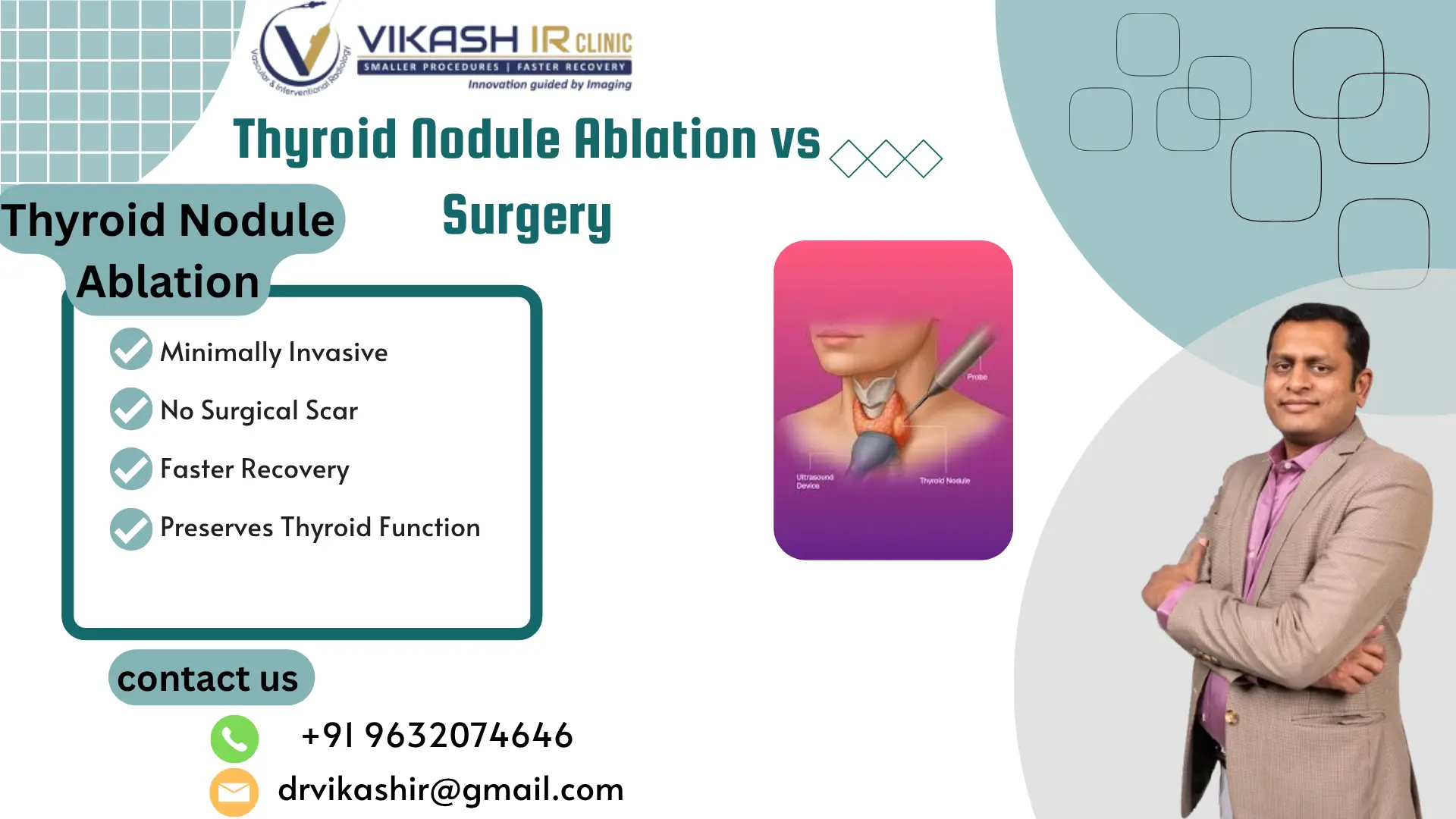
A thyroid nodule is a lump that develops within the thyroid gland. Most thyroid nodules are benign, but some may cause symptoms, grow over time, affect thyroid function, or require evaluation for possible malignancy. Once a nodule is diagnosed, patients often want to know which treatment is safest and most appropriate.
Thyroid Nodule Ablation vs Surgery is an important decision because both approaches have different purposes, benefits, recovery requirements, and limitations. For selected benign thyroid nodules, minimally invasive ablation may provide an alternative to conventional surgery. However, surgery remains an important treatment when cancer is suspected or when the clinical situation requires removal of part or all of the thyroid.
For patients considering Thyroid Nodule Treatment Without Surgery, the first step is not simply choosing ablation. A specialist needs to confirm the type of nodule, its size, symptoms, ultrasound characteristics, cytology, thyroid function, and overall patient factors.
This guide explains Thyroid Nodule Ablation vs Surgery, how each procedure works, who may benefit, and what patients should discuss with an experienced interventional radiologist such as Dr. Vikash Chennur in Bengaluru.
Understanding Thyroid Nodules and Their Diagnosis
What is a thyroid nodule?
A thyroid nodule is an abnormal growth or area within the thyroid gland. Nodules may be solid, cystic, or have mixed characteristics. They can occur at any age and are often discovered incidentally during a routine examination or imaging performed for another reason.
Many thyroid nodules do not cause symptoms. Others may become noticeable as they increase in size.
Common symptoms may include:
- A visible or palpable lump in the neck
- A feeling of pressure in the throat
- Difficulty swallowing
- Neck discomfort
- A sensation of something being stuck in the throat
- Voice changes in some cases
- Cosmetic concerns because of a visible neck swelling
- Rarely, breathing difficulty when a large nodule compresses nearby structures
The presence of symptoms does not automatically mean that a nodule is cancerous. Proper diagnostic evaluation is essential before deciding between Thyroid Nodule Ablation vs Surgery.
What causes thyroid nodules?
The exact cause varies between patients. Thyroid nodules may be associated with changes in thyroid tissue, thyroid inflammation, iodine-related factors, benign growths, cyst formation, or other thyroid conditions.
Some nodules can produce excess thyroid hormone, while many do not affect thyroid hormone levels.
How are thyroid nodules diagnosed?
Evaluation generally begins with a clinical examination and thyroid ultrasound. Blood tests such as thyroid-stimulating hormone (TSH) may be recommended to assess thyroid function.
Depending on the ultrasound findings and clinical assessment, a fine-needle aspiration biopsy may be recommended. The biopsy helps determine whether the nodule has benign, suspicious, or malignant characteristics.
A complete evaluation may include:
- Medical history and neck examination
- Thyroid function tests
- High-resolution thyroid ultrasound
- Fine-needle aspiration cytology when indicated
- Additional imaging or testing when clinically required
This diagnostic process is particularly important before choosing Thyroid Nodule Ablation vs Surgery, because ablation is generally considered for appropriately evaluated benign nodules rather than as a substitute for cancer surgery.
Thyroid Nodule Ablation vs Surgery: How the Treatments Differ
When discussing Thyroid Nodule Ablation vs Surgery, it is important to understand that these treatments work differently.
What is thyroid nodule ablation?
Thyroid Nodule Ablation is a minimally invasive treatment designed to reduce the size and symptoms of selected thyroid nodules without surgically removing the thyroid gland.
Depending on the characteristics of the nodule and the specialist’s recommendation, thermal ablation techniques such as radiofrequency ablation (RFA) may be considered.
During the procedure, a thin needle-like electrode is guided into the nodule, usually under ultrasound guidance. Controlled energy is delivered to targeted tissue. Over time, the treated portion of the nodule shrinks as the body gradually absorbs the damaged tissue.
This approach can be particularly useful for selected patients with benign, symptomatic, or cosmetically concerning nodules.
Who may be considered for ablation?
Ablation may be considered when a patient has:
- A confirmed benign thyroid nodule
- Symptoms caused by the nodule
- A progressively enlarging benign nodule
- Cosmetic concerns due to the nodule
- A desire to avoid an operation when clinically appropriate
- A suitable nodule based on ultrasound and cytology findings
Not every thyroid nodule is suitable for ablation. Nodule size, location, composition, proximity to important structures, previous treatment, thyroid function, and cytology all influence the decision.
What happens during surgery?
Thyroid surgery involves physically removing thyroid tissue. Depending on the diagnosis, this may involve removal of one thyroid lobe or a larger portion of the thyroid gland.
Surgery can be the preferred or necessary treatment when:
- Thyroid cancer is confirmed or strongly suspected
- A nodule has suspicious characteristics requiring surgical management
- There is significant compression of the airway or swallowing structures
- The nodule is not appropriate for ablation
- There are other thyroid conditions requiring surgery
Thyroid Nodule Ablation vs Surgery: Key comparison
| Factor | Thyroid Nodule Ablation | Surgery |
| Approach | Minimally invasive | Surgical |
| Thyroid tissue | Usually preserved | Part or all may be removed |
| Anaesthesia | Often performed with local anaesthesia and appropriate pain control | Usually requires general anaesthesia |
| Incision | No conventional surgical incision | Surgical neck incision |
| Hospital stay | Often outpatient/day-care depending on case | May require hospital stay |
| Recovery | Generally quicker | Usually longer |
| Scar | No conventional surgical scar | Surgical scar may remain |
| Thyroid function | Often preserved | May be affected depending on extent of surgery |
| Cancer treatment | Not a replacement for indicated cancer surgery | Established treatment for appropriate thyroid cancers |
The choice in Thyroid Nodule Ablation vs Surgery should therefore be based on diagnosis and individual clinical factors rather than simply selecting the procedure with the shortest recovery.
Benefits of thyroid nodule ablation
For appropriately selected patients, potential benefits of Thyroid Nodule Ablation vs Surgery include avoiding a conventional operation, preserving thyroid tissue, limited skin injury, shorter recovery, and improvement in symptoms or cosmetic appearance as the nodule decreases in volume.
However, results vary. The nodule usually does not disappear immediately. Shrinkage occurs progressively over months, and follow-up ultrasound is important to monitor the response.
Thyroid Nodule Ablation vs Surgery: Recovery, Results and Choosing the Right Option
Recovery after thyroid nodule ablation
Recovery after ablation is generally shorter than recovery following conventional thyroid surgery. Many appropriately selected patients can return to routine activities relatively quickly, depending on their individual circumstances and the treating specialist’s advice.
Temporary effects can include mild neck discomfort, tenderness, swelling, or bruising. Rare complications can occur, which is why the procedure should be performed by an appropriately trained specialist with experience in thyroid interventions.
Follow-up imaging helps assess how much the nodule has reduced over time.
Recovery after thyroid surgery
Recovery following thyroid surgery varies according to the type and extent of the operation. Patients may experience temporary neck discomfort, swelling, or changes in activity levels during the initial recovery period.
Because thyroid tissue may be removed, some patients require thyroid hormone replacement, particularly after total thyroidectomy. The need for medication depends on the amount of thyroid tissue removed and the patient’s thyroid function.
What factors determine the right treatment?
The decision in Thyroid Nodule Ablation vs Surgery should be individualized. Important considerations include:
- Whether the nodule is benign or malignant
- Cytology/biopsy findings
- Ultrasound characteristics
- Nodule size and location
- Presence and severity of symptoms
- Cosmetic concerns
- Thyroid hormone levels
- Previous thyroid procedures
- Patient preference
- Overall health
- Experience and recommendation of the treating specialist
A patient looking for Thyroid Nodule Treatment Without Surgery should first establish whether the nodule is actually suitable for a minimally invasive approach. Avoiding surgery should never mean avoiding appropriate diagnostic evaluation.
Thyroid Nodule Ablation vs Surgery: Which is better?
There is no single treatment that is better for every patient. Thyroid Nodule Ablation vs Surgery is a patient-specific decision.
For an appropriately selected benign, symptomatic thyroid nodule, ablation may offer an effective minimally invasive alternative. For suspected or confirmed thyroid cancer, surgery may be necessary because the treatment objective is different.
In Bengaluru, patients searching for Thyroid Nodule Treatment Without Surgery or Thyroid Nodule Ablation should seek evaluation from a specialist who can review their ultrasound and biopsy results before recommending treatment.
Frequently Asked Questions
1. Is thyroid nodule ablation an alternative to surgery?
For selected benign thyroid nodules, ablation can be an alternative to conventional surgery. However, it is not appropriate for every nodule, particularly when cancer is suspected or confirmed.
2. Is thyroid nodule ablation painful?
The procedure is generally performed with local anaesthesia and pain-control measures. Some patients may experience temporary discomfort, tenderness, or a sensation of pressure during or after treatment.
3. Will thyroid nodule ablation remove the entire nodule?
Usually, ablation does not physically remove the nodule. Instead, the targeted tissue is treated and gradually shrinks as the body processes it.
4. Can thyroid ablation be used for thyroid cancer?
Thyroid ablation should not automatically be considered a replacement for cancer surgery. The appropriate treatment for a malignant nodule depends on the type, size, location, spread, and other clinical factors.
5. How long does it take for a thyroid nodule to shrink after ablation?
Nodule reduction occurs gradually rather than immediately. Follow-up ultrasound examinations are used to monitor the reduction over time.
6. Can thyroid function remain normal after ablation?
One potential advantage of appropriately performed ablation is preservation of surrounding thyroid tissue. However, thyroid function varies between patients and should be monitored as advised by the treating doctor.
7. Is thyroid nodule ablation available in Bengaluru?
Yes, minimally invasive thyroid nodule treatment is available in Bengaluru through appropriately trained specialists. Patients should undergo individual assessment before deciding whether ablation is suitable.
8. How do I choose between thyroid ablation and surgery?
The choice depends on the diagnosis, biopsy results, ultrasound findings, nodule characteristics, symptoms, thyroid function, and your personal treatment preferences. A specialist consultation is important before making the decision.
9. Can I get Thyroid Nodule Treatment Without Surgery for a benign nodule?
In selected cases, yes. Thyroid Nodule Treatment Without Surgery may include image-guided ablation for suitable benign nodules. Your doctor must first confirm that the nodule meets the appropriate clinical criteria.
Thyroid Nodule Ablation vs Surgery: Making an Informed Decision
Choosing between Thyroid Nodule Ablation vs Surgery should never be based only on recovery time, fear of surgery, or online information. The correct approach depends on the individual patient’s diagnosis and treatment goals.
For suitable benign nodules, Thyroid Nodule Ablation can provide a minimally invasive option that may reduce nodule volume and symptoms while preserving much of the normal thyroid tissue. Surgery remains an important and sometimes essential treatment when malignancy is suspected or confirmed or when the nodule’s characteristics make ablation unsuitable.
There is also no universal treatment price for Thyroid Nodule Ablation vs Surgery. The overall treatment plan and cost can vary depending on the size and number of nodules, investigations required, procedure complexity, hospital or facility requirements, follow-up, and the patient’s individual condition. A specialist should provide treatment-specific guidance after evaluation rather than relying on a fixed quoted figure.
If you are considering Thyroid Nodule Treatment Without Surgery in Bengaluru, consult Dr. Vikash Chennur for an individualized assessment of your thyroid nodule. Your ultrasound, thyroid tests, biopsy/cytology reports, symptoms, and treatment goals can be reviewed to determine whether Thyroid Nodule Ablation or surgery is more appropriate for your condition.
Call Dr. Vikash Chennur
Email Dr. Vikash Chennur
[drvikashir@gmail.com]
Visit Dr. Vikash Chennur
Book a consultation to discuss Thyroid Nodule Ablation and minimally invasive thyroid nodule treatment.