
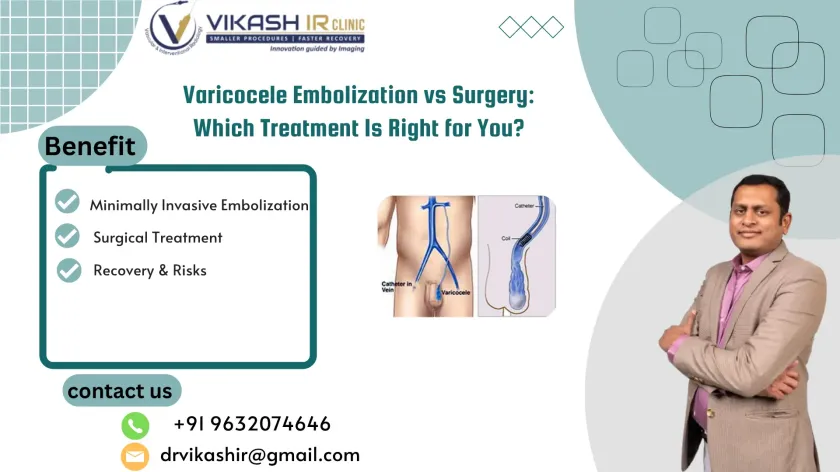
Choosing the right treatment for a varicocele can be important for men experiencing testicular discomfort, enlarged scrotal veins, or fertility concerns. Varicocele Embolization is a minimally invasive treatment performed by an interventional radiologist, while varicocele surgery involves closing the affected veins through a surgical procedure. Both approaches aim to improve blood drainage and reduce abnormal venous pressure.
Understanding Varicocele Embolization vs Surgery: Which Treatment Is Right for You? starts with learning about the condition, its symptoms, diagnosis, treatment methods, and expected recovery. The most suitable approach depends on the patient’s symptoms, vein anatomy, fertility goals, medical history, and treatment preferences.
At Vikash IR Clinic in J. P. Nagar, Bengaluru, Dr Vikash Chennur, AIIMS Gold Medalist and Endovascular Interventional Radiologist, can help eligible patients understand minimally invasive treatment options and determine whether further assessment is appropriate.
1. What Is a Varicocele and When Does It Need Treatment?
A varicocele is an enlargement of the veins inside the scrotum, similar to varicose veins in the legs. It develops when blood flows backward or drains inefficiently through the veins surrounding the testicles. Although many varicoceles do not cause problems, some may contribute to persistent discomfort, testicular growth changes, or impaired sperm production.
What Causes a Varicocele?
The main cause is abnormal blood flow through the testicular veins, often associated with poorly functioning venous valves. Blood can accumulate in these veins, increasing pressure and causing them to enlarge.
Varicoceles occur more frequently on the left side because of the anatomy of the left testicular vein. However, they can affect the right side or both sides.
Common Symptoms of Varicocele
Many men have no noticeable symptoms. When symptoms occur, they may include:
- Dull, aching pain or heaviness in the scrotum.
- Discomfort that worsens after prolonged standing or exercise.
- Enlarged or twisted veins that feel like a bag of worms.
- A difference in testicular size.
- Difficulty conceiving or abnormal semen analysis results.
Sudden or severe testicular pain requires urgent medical assessment because it may indicate another condition requiring immediate treatment.
How Is a Varicocele Diagnosed?
Diagnosis usually begins with a medical history and physical examination. A doctor may examine the scrotum while the patient is standing and lying down to assess the enlarged veins.
A scrotal Doppler ultrasound may be recommended when the diagnosis is uncertain, symptoms require further investigation, or testicular blood flow needs assessment. Men undergoing fertility evaluation may also need semen analysis and additional investigations based on their circumstances.
A diagnosis does not automatically mean treatment is necessary. The decision depends on symptoms, examination findings, fertility concerns, and other clinical factors.
When Is Varicocele Treatment Recommended?
Varicocele treatment may be considered when a patient experiences persistent pain despite conservative management, has a clinically palpable varicocele with infertility and abnormal semen parameters, or has evidence of impaired testicular development.
Men with an incidental varicocele and no relevant symptoms or fertility concerns may only need observation. A specialist should determine whether intervention is appropriate after reviewing the individual condition.
2. Varicocele Embolization vs Surgery: Procedure, Benefits and Risks
When comparing Varicocele Embolization vs Surgery: Which Treatment Is Right for You?, it is important to understand that both procedures aim to stop abnormal blood flow through the affected veins, but they use different techniques.
What Is Varicocele Embolization?

Varicocele Embolization is a minimally invasive, image-guided procedure performed by a trained interventional radiologist. It uses a thin catheter to reach and block the abnormal vein without requiring a surgical incision in the groin or scrotum.
The procedure generally involves these steps:
- A small needle puncture is made in a vein, usually in the groin or neck.
- A thin catheter is guided toward the affected testicular vein under fluoroscopic X-ray guidance.
- Contrast imaging helps identify abnormal blood flow and relevant venous pathways.
- Tiny coils, an embolic agent, or a combination of materials are used to block the abnormal vein.
- The catheter is removed, and the patient is monitored before discharge.
The procedure is commonly performed as day care. Local anaesthesia is often used, sometimes with sedation. The duration varies according to the patient’s venous anatomy and procedural complexity.
Potential benefits include:
- No surgical incision in the groin or scrotum.
- Often a short initial recovery period.
- Avoidance of surgical dissection around the testicular artery and lymphatic vessels.
- The possibility of treating recurrent varicocele after previous surgery.
- Image-guided assessment of venous anatomy during treatment.
Possible risks include bruising at the access site, temporary discomfort, contrast reactions, radiation exposure, technical failure, and recurrence. Embolization may not be feasible in every patient because some veins are difficult to access.
What Is Varicocele Surgery?

Varicocele surgery, known as varicocelectomy, involves closing or tying off the affected veins. Microsurgical varicocelectomy is an established technique performed by a urologist using magnification to identify the veins and preserve important structures.
The surgeon makes a small incision, identifies the abnormal veins, and ligates them while taking care to protect the testicular artery and lymphatic vessels.
Potential benefits include direct identification of the affected veins and favourable recurrence outcomes with experienced microsurgical techniques. Surgery has strong supporting evidence for selected men with infertility, a palpable varicocele, and abnormal semen parameters.
However, surgery involves an incision and may cause wound pain, bruising, infection, hydrocele formation, or persistent or recurrent varicocele. Rarely, injury to the testicular artery can occur.
Key Differences Between Embolization and Surgery
| Feature | Varicocele embolization | Microsurgical varicocelectomy |
| Specialist | Interventional radiologist | Urologist |
| Technique | Catheter-based vein closure | Surgical vein ligation |
| Incision | Small needle puncture | Small surgical incision |
| Anaesthesia | Usually local, sometimes sedation | Commonly general anaesthesia |
| Imaging | Fluoroscopy and contrast | Direct visualisation with magnification |
| Initial recovery | Often faster | May take longer |
| Radiation | Yes | No routine fluoroscopic exposure |
| Recurrence | Possible | Possible |
Neither method guarantees success. The outcome depends on venous anatomy, the chosen technique, the specialist’s experience, and the patient’s individual condition.
Success Rates, Recurrence and Possible Complications
Success may refer to technical closure of the abnormal vein, pain improvement, better semen parameters, or pregnancy. These are different outcomes, and one does not automatically guarantee another.
Both embolization and microsurgical surgery can provide effective treatment. Microsurgical techniques generally have favourable recurrence and hydrocele outcomes compared with several other surgical approaches. Embolization is also an established option, particularly for patients who prefer minimally invasive treatment or have recurrent disease after surgery.
A varicocele can persist or recur after either procedure because of untreated veins, collateral pathways, or anatomical factors. Your specialist should explain the likely benefits, risks, and possibility of further treatment based on your findings.
Recovery Time After Embolization vs Surgery
After uncomplicated embolization, many patients return to light activities within one or two days. Following surgery, light activities may resume within several days, although some patients need one to two weeks before returning comfortably to work.
Heavy lifting, strenuous exercise, and other activities should be postponed until the treating specialist provides clearance. Fertility outcomes also take time to assess; semen analysis may be repeated after approximately three months or according to the clinician’s advice.
3. Which Is Better: Varicocele Embolization or Surgery?
There is no universally superior option. When considering Varicocele Embolization vs Surgery: Which Treatment Is Right for You?, the decision should reflect the reason for treatment, fertility goals, previous procedures, anatomy, and recovery preferences.
Benefits of Varicocele Embolization
Embolization may be suitable for patients who want to avoid a surgical incision, prefer a catheter-based procedure, or need assessment for a recurrent varicocele after surgery. It usually allows a relatively quick return to routine activities.
It also enables the interventional radiologist to examine venous pathways using contrast imaging. However, the procedure involves radiation exposure and may be technically challenging in some patients.
Benefits of Microsurgical Varicocelectomy
Microsurgical varicocelectomy provides direct visualisation of the affected veins and has established clinical evidence in appropriately selected men with infertility. Magnification helps the surgeon preserve the testicular artery and lymphatic vessels.
It may be preferred when clinical findings favour a surgical approach or when the patient and urologist determine that surgery best meets the treatment goals.
Varicocele Embolization vs Surgery for Fertility
Both approaches may improve semen parameters in selected patients, but treatment does not guarantee conception or a live birth.
For fertility-related decisions, doctors consider whether the varicocele is palpable, whether semen analysis is abnormal, the duration of infertility, and the reproductive health of both partners when applicable.
Microsurgical repair has substantial evidence supporting its use in appropriately selected infertile men. Embolization is an alternative for suitable patients, although the strength of comparative evidence varies across studies. A reproductive urologist and interventional radiologist can help determine the most appropriate option.
Which Treatment Is Better for Varicocele Pain?
Both procedures can relieve varicocele-related discomfort. Embolization may appeal to patients prioritising a minimally invasive approach and shorter initial recovery. Surgery may be preferred when the anatomy, clinical findings, or patient preferences favour microsurgical repair.
Before treatment, the doctor should confirm that the varicocele is likely to be responsible for the pain. Persistent discomfort can have other causes, and pain relief is not guaranteed with either procedure.
What Factors Influence the Treatment Decision?
The choice among Varicocele Treatment Options depends on several individual factors:
- Symptoms: Persistent pain, testicular changes, and fertility concerns may require different assessments.
- Venous anatomy: The location and accessibility of the abnormal veins affect procedural suitability.
- Previous treatment: Embolization may be considered for persistent or recurrent varicocele after surgery.
- Fertility goals: Semen results and the couple’s conception timeline are important.
- Medical history: Anaesthetic suitability, kidney function, and contrast allergy may influence planning.
- Recovery needs: Work demands, activity levels, and personal preferences should be discussed.
- Specialist expertise: The experience of the treating team is important for both approaches.
Patients seeking Varicocele Embolization in Bengaluru can consult a qualified interventional radiologist to discuss their symptoms, diagnostic findings, and suitability for minimally invasive treatment. A consultation is necessary before deciding on a procedure.
4. Frequently Asked Questions About Varicocele Embolization vs Surgery
Is Varicocele Embolization Better Than Surgery?
Neither option is best for every patient. Embolization avoids a surgical incision and often offers a shorter initial recovery, while microsurgical varicocelectomy has established evidence for selected men with infertility. The decision depends on individual findings and treatment goals.
Is Varicocele Embolization Painful?
The procedure is generally well tolerated. Local anaesthesia is used at the access site, and sedation may be provided when appropriate. Mild discomfort or bruising may occur afterward.
How Long Does Recovery Take After Varicocele Embolization?
Many patients return to routine activities within 24–48 hours. Recovery varies, and strenuous exercise or heavy lifting should be avoided until the doctor provides clearance.
Can Varicocele Return After Embolization or Surgery?
Yes. Recurrence or persistence is possible after either procedure. If symptoms continue or return, the specialist may recommend a clinical examination, ultrasound when appropriate, and further treatment if necessary.
Which Treatment Is Better for Male Fertility?
Both procedures may help selected men, but neither guarantees pregnancy. Men with a palpable varicocele, infertility, and abnormal semen parameters should discuss treatment with a reproductive urologist.
Can Varicocele Be Treated Without Surgery?
Yes. Varicocele Embolization treats abnormal veins using a catheter and image guidance rather than a surgical incision. However, not every patient is suitable, and some varicoceles do not require treatment.
Is Varicocele Embolization Safe?
It is generally considered safe when performed by a trained interventional radiologist. Potential risks include access-site bleeding, temporary pain, contrast reactions, radiation exposure, and recurrence. The doctor should review the patient’s medical history before treatment.
How Much Does Varicocele Embolization Cost in Bengaluru?
The cost depends on the hospital or facility, procedural complexity, embolization materials, investigations, and individual care requirements. A reliable estimate should be provided by the treating facility after assessment; a fixed price should not be assumed for every patient.
When Can I Return to Work or Exercise After Treatment?
Many patients return to desk work within a few days after embolization, while surgical recovery may take longer. Heavy lifting and strenuous exercise should be resumed only after the treating specialist confirms that it is safe.
Can Every Varicocele Be Treated With Embolization?
No. Some venous anatomies or technical factors may make embolization difficult or unsuitable. An interventional radiologist evaluates the clinical findings and relevant imaging before recommending treatment.
Conclusion
Varicocele Embolization and microsurgical varicocelectomy are established treatment options, but the right approach depends on the patient’s symptoms, anatomy, fertility goals, medical history, and preferences. A specialist consultation helps clarify the expected benefits, risks, recovery, and follow-up requirements.
If you are considering Varicocele Embolization in Bengaluru, Dr Vikash Chennur, AIIMS Gold Medalist and Endovascular Interventional Radiologist, can assess your condition and discuss whether a minimally invasive approach is suitable.
Book an appointment for a personalised assessment.
Dr Vikash Chennur | Interventional Radiology
- Phone: +919632074646
- Location: 1st Floor, 15, Bannerghatta Road, Sarakki Industrial Layout, 3rd Phase, J. P. Nagar, Bengaluru, Karnataka 560078.