
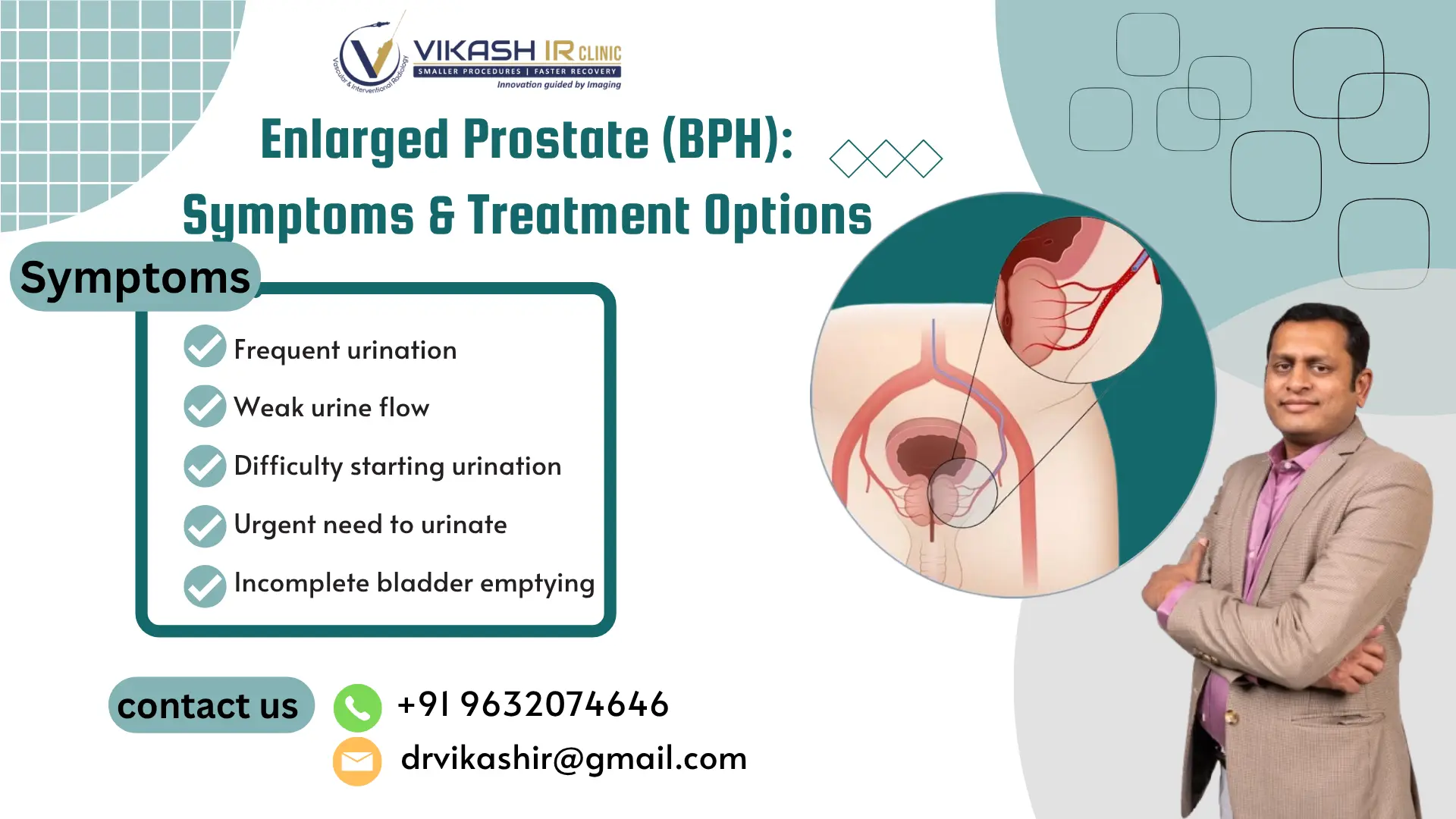
Enlarged Prostate (BPH): Symptoms Treatment Options is an important topic for men, particularly as prostate enlargement becomes more common with increasing age. Benign prostatic hyperplasia (BPH) is a non-cancerous enlargement of the prostate that can gradually narrow the urethra and interfere with normal urine flow. Although BPH is not prostate cancer, untreated or poorly controlled symptoms can significantly affect sleep, daily activities, comfort, and quality of life.
Many men initially ignore urinary changes because they assume they are a normal part of ageing. However, symptoms such as frequent urination, a weak stream, difficulty starting urination, or repeated nighttime trips to the bathroom deserve medical evaluation.
Modern treatment has expanded beyond medicines and conventional surgery. Depending on prostate size, symptom severity, urinary function, overall health, and personal preferences, treatment may include lifestyle changes, medications, minimally invasive procedures, or surgery. One minimally invasive option is Prostatic Artery Embolization for BPH, performed by an experienced interventional radiologist.
This guide explains Enlarged Prostate (BPH): Symptoms Treatment Options, including symptoms, causes, diagnosis, treatment choices, recovery, and when minimally invasive prostate artery embolization may be considered.
Symptoms, Causes & Diagnosis
Symptoms of Enlarged Prostate
BPH symptoms are generally classified as lower urinary tract symptoms (LUTS). They can develop gradually and may vary considerably from one man to another.
Common symptoms include:
- Frequent urination during the day
- Waking several times at night to urinate
- Sudden or urgent need to urinate
- Difficulty starting urination
- Weak or slow urine stream
- Stopping and starting while urinating
- Dribbling at the end of urination
- Feeling that the bladder has not emptied completely
- Straining to urinate
- In some cases, urinary retention
Nighttime urination, known as nocturia, can be particularly disruptive because repeated sleep interruptions may contribute to daytime fatigue and reduced concentration.
Severe urinary obstruction can sometimes lead to complications such as urinary retention, recurrent urinary infections, bladder problems, or impaired kidney function. Therefore, persistent or worsening symptoms should not simply be attributed to ageing.
Causes and Risk Factors
The exact biological process behind BPH is complex, but age-related hormonal changes and prostate tissue growth play important roles. BPH develops primarily in the transition zone of the prostate, which surrounds part of the urethra. As this tissue grows, it can increase resistance to urine leaving the bladder.
Risk factors may include:
- Increasing age
- Family history of prostate enlargement
- Hormonal changes associated with ageing
- Obesity and metabolic health factors
- Reduced physical activity
- Certain medical conditions
It is important to distinguish BPH from prostate cancer. The two conditions can coexist, but BPH itself is not cancer.
Diagnosis
A doctor may use several assessments to determine the cause and severity of urinary symptoms. Depending on the individual case, evaluation may include:
- Detailed medical and urinary history
- Physical examination and digital rectal examination when appropriate
- Urine testing
- Blood tests, including PSA when clinically indicated
- Ultrasound to assess prostate size and bladder emptying
- Measurement of post-void residual urine
- Uroflowmetry to evaluate urine flow
- Additional imaging or urological investigations when necessary
A symptom questionnaire such as the International Prostate Symptom Score (IPSS) may also help assess symptom severity and monitor treatment response.
A proper diagnosis is essential because urinary symptoms can have causes other than BPH, including urinary infection, bladder disorders, urethral narrowing, medications, or prostate cancer.
Treatment & Procedure Options
Conservative Management and Medicines
For men with mild symptoms, doctors may initially recommend monitoring and lifestyle adjustments. These can include reducing evening fluid intake, limiting caffeine and alcohol, managing constipation, maintaining physical activity, and reviewing medications that may worsen urinary symptoms.
Medications may be prescribed when symptoms interfere with daily life. Common options include alpha-blockers, which relax prostate and bladder-neck muscles, and 5-alpha-reductase inhibitors, which can gradually reduce prostate volume in selected men. Some patients may require combination therapy.
Medication selection depends on prostate size, symptom pattern, blood pressure, other medications, sexual health considerations, and overall medical condition.
Surgical Treatment
When symptoms are severe, complications occur, or medicines do not provide sufficient relief, procedural or surgical treatment may be appropriate.
Depending on prostate characteristics and patient suitability, options can include transurethral procedures, laser techniques, enucleation procedures, water-vapor therapy, aquablation, or other approaches. The most appropriate treatment varies from patient to patient. Current AUA guidance recognizes several procedural options, with treatment selection based on prostate size, anatomy, symptoms, patient goals, and clinician expertise.
Prostatic Artery Embolization for BPH
Prostatic Artery Embolization for BPH is a minimally invasive procedure performed by an interventional radiologist. Instead of removing prostate tissue through the urethra, the procedure works by reducing blood flow to selected arteries supplying the enlarged prostate.
During PAE, the doctor uses imaging guidance to navigate a thin catheter through an artery, commonly through the wrist or groin, toward the arteries supplying the prostate. Tiny embolic particles are then delivered carefully into the appropriate vessels. Reduced blood supply can cause the prostate tissue to shrink over time, potentially improving urinary symptoms.
The procedure requires detailed vascular imaging and careful patient selection. Not every man with BPH is an appropriate candidate, so consultation with both the relevant specialists and an experienced interventional radiologist can be valuable.
It is also important to understand that recommendations concerning PAE have evolved. Older AUA guidance did not recommend PAE outside clinical trials, while newer 2026 AUA guidance is now available; therefore, patients should discuss current evidence, local expertise, suitability, and alternatives with their treating specialists rather than assuming one treatment is universally best.
Benefits of Minimally Invasive PAE
For appropriately selected patients, potential advantages of PAE may include:
- No surgical removal of prostate tissue
- Small vascular access site rather than a large surgical incision
- Minimally invasive treatment
- Potential improvement in urinary symptoms
- Short hospital stay in many cases
- Relatively quick return to routine activities
- May be an option for some men who want to avoid conventional surgery
However, results vary. PAE is not risk-free, and possible complications can include access-site bleeding or bruising, infection, transient urinary symptoms, non-target embolization, or incomplete symptom improvement. A detailed pre-procedure assessment helps reduce avoidable risks.
Recovery, Comparison & FAQs
Recovery After PAE
Recovery following Prostatic Artery Embolization for BPH is generally less demanding than recovery from many conventional surgical procedures, although individual experiences vary.
Patients are monitored after the procedure and may experience temporary pelvic discomfort, urinary frequency, mild fever, or burning during urination. These symptoms are usually managed with medicines and supportive care when they occur.
The improvement in urinary symptoms is not necessarily immediate. Because PAE works by gradually reducing blood supply and causing prostate tissue changes, improvement may develop over the following weeks and continue over subsequent months.
Your doctor will provide individualized instructions regarding medicines, hydration, activity, and follow-up.
PAE vs Conventional Surgery
| Feature | Prostatic Artery Embolization | Conventional Transurethral/Surgical Treatment |
| Approach | Through a small arterial catheter | Instrument enters through the urinary passage or surgical access |
| Prostate tissue | Blood supply is reduced rather than directly removing tissue | Tissue is removed or treated directly |
| Incision | Usually no large incision | Depends on procedure |
| Hospital stay | Often short | Varies by procedure |
| Recovery | Generally relatively quick | Varies according to technique |
| Suitability | Depends on prostate anatomy and vascular anatomy | Depends on prostate size, anatomy and health |
| Sexual/urinary effects | Individual outcomes vary | Depend on the specific procedure |
There is no single “best” BPH treatment for every patient. A personalized assessment should consider symptoms, prostate volume, urinary obstruction, medications, medical history, sexual function goals, and the patient’s preference.
FAQs
1. What is BPH?
Benign prostatic hyperplasia is a non-cancerous enlargement of the prostate that can cause lower urinary tract symptoms by increasing resistance to urine flow.
2. Is an enlarged prostate the same as prostate cancer?
No. BPH is benign and does not itself mean that a man has prostate cancer. However, appropriate medical evaluation is important because urinary symptoms can have several causes.
3. Can an enlarged prostate be treated without surgery?
Yes. Depending on symptom severity, treatment may involve lifestyle measures, medication, minimally invasive procedures, or other interventions. Prostatic Artery Embolization for BPH is one minimally invasive option for appropriately selected patients.
4. Is PAE painful?
PAE is performed using local anesthesia and image guidance. Some patients may experience temporary discomfort or urinary symptoms afterward, but the level of discomfort varies.
5. How long does it take to recover after PAE?
Recovery varies between patients. Many people can resume routine activities relatively quickly, but the timeline should be determined by the treating doctor based on the procedure and individual health.
6. Does PAE shrink the prostate?
PAE reduces blood flow to targeted prostate tissue, which can lead to prostate volume reduction over time and improvement in urinary symptoms in appropriately selected patients.
7. Can PAE be performed for a very large prostate?
PAE may be considered in selected patients with enlarged prostates, but prostate size is only one factor. Vascular anatomy, symptoms, bladder function, overall health, and previous treatments also matter.
8. Will BPH symptoms come back after treatment?
Symptoms can recur after any BPH treatment. Long-term outcomes vary depending on the treatment used, prostate characteristics, and individual patient factors.
9. When should I see a specialist for BPH?
Seek medical evaluation if you have persistent weak urine flow, difficulty starting urination, frequent nighttime urination, incomplete bladder emptying, recurrent urinary infections, blood in the urine, or an inability to urinate.
10. Who performs PAE?
PAE is performed by an interventional radiologist with specialized training in image-guided vascular procedures. Coordination with a urologist can also be important when evaluating the full range of BPH treatment options.
About Dr. Vikash Chennur & His Services
Dr Vikash Chennur | AIIMS Gold Medalist | Best Endovascular Interventional Radiologist is an experienced interventional radiologist practicing in Bengaluru. His professional profile lists MBBS, MD in Radio Diagnosis/Radiology, and DNB in Radio Diagnosis, with specialist experience across India, Canada, and Australia. He is also described as an AIIMS New Delhi Gold Medalist and has advanced international training.
His practice focuses on minimally invasive, image-guided treatments. Services listed by his clinic include Prostate Artery Embolization, uterine fibroid embolization, thyroid nodule ablation, thyroid artery embolization, varicocele embolization, varicose vein treatment, fibroadenoma treatment, interventional pain management, image-guided tumor ablation, liver cancer ablation, TACE, hepatobiliary and portal hypertension interventions, genicular artery embolization, and other interventional radiology procedures.
His approach emphasizes individualized treatment planning and selecting an intervention only when it is clinically appropriate. Interventional radiology uses imaging to guide small catheters and instruments to targeted areas, allowing many treatments to be performed without large surgical incisions.
Conclusion
Enlarged Prostate (BPH): Symptoms Treatment Options range from lifestyle modifications and medicines to minimally invasive procedures and surgery. The right choice depends on symptom severity, prostate size, urinary function, overall health, anatomy, previous treatment, and personal preferences.
For men considering an alternative to conventional prostate surgery, Prostatic Artery Embolization for BPH may be worth discussing with an experienced interventional radiologist. It is a specialized procedure and should be recommended only after appropriate clinical and imaging evaluation.
If persistent urinary symptoms are affecting your sleep, work, travel, or quality of life, do not ignore them. Early assessment can help identify the underlying cause and provide a clearer understanding of available treatment options.
Book an Appointment with Dr. Vikash Chennur
If you are looking for an AIIMS Gold Medalist and experienced endovascular interventional radiologist in Bengaluru for evaluation of BPH and minimally invasive treatment options, consult Dr. Vikash Chennur.
Clinic: Vikash IR Clinic, Docube Healthcare
Address: 1st Floor, No. 15, Bannerghatta Road, 3rd Phase, J. P. Nagar, Bengaluru, Karnataka 560076, India.
Phone: +91 96320 74646
Book a consultation to discuss your symptoms, understand whether PAE is suitable for you, and explore a personalized treatment plan with Dr. Vikash Chennur.