Thyroid Radiofrequency Ablation vs Surgery: Which Is Better for a Benign Nodule?
You have been told your thyroid nodule is benign, but it is large, visible or uncomfortable. Now you face a real decision: have surgery, which has been the standard for decades, or choose thyroid radiofrequency ablation (RFA), a newer procedure that treats the nodule through a needle with no incision. If you are comparing thyroid radiofrequency ablation vs surgery, this guide gives you a fair, evidence-based comparison so you can discuss it with your doctor.
It comes from the team at Vikash IR Clinic in Bengaluru, where Dr. Vikash Chennur, an interventional radiologist, offers thyroid nodule ablation treatment in Bangalore. We will also tell you when surgery is the better choice, because the right treatment depends on your nodule.
The Short Answer
For a benign nodule that causes symptoms, RFA is a reasonable alternative to surgery in carefully selected patients. It is less invasive, avoids a neck scar, does not need general anaesthesia and usually preserves thyroid function. For cancer, suspicious nodules or very large and complex goitres, surgery generally remains the standard treatment. Neither option is “better” for everyone.
Before Either Option: Confirm the Nodule Is Benign
This step comes first and cannot be skipped. For any nodule you need:
- Thyroid function tests (TSH, with T3 and T4 if needed)
- A neck ultrasound with risk assessment
- FNAC (fine needle aspiration cytology), ideally confirmed benign, and sometimes repeated
RFA is for benign nodules only. If your results suggest cancer or are indeterminate, you should be guided to the correct treatment, which is usually surgery. A responsible doctor will insist on this before offering ablation. If you are still at the stage of understanding your nodule, read our guide to thyroid nodule treatment without surgery.
What Is Thyroid Radiofrequency Ablation?
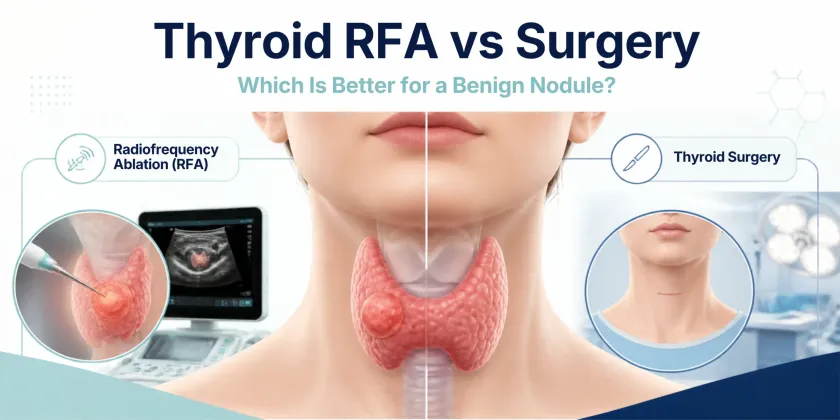
RFA is an image-guided procedure. Under local anaesthesia and live ultrasound, a thin electrode is placed into the nodule through the skin of the neck. Radiofrequency energy heats and destroys the nodule tissue in a controlled way, while the surrounding thyroid and neck structures are protected. The body slowly absorbs the treated tissue over the following months, and the nodule shrinks. The procedure usually takes under an hour and most people go home the same day.
What Is Thyroid Surgery?
Thyroid surgery removes part or all of the thyroid gland under general anaesthesia:
- Hemithyroidectomy (lobectomy) removes one lobe, which contains the nodule
- Total thyroidectomy removes the whole gland
Surgery removes the nodule immediately and gives a tissue diagnosis. It is the proven standard for thyroid cancer and for large nodules or goitres causing significant compression.
Side-by-Side Comparison
| Radiofrequency Ablation | Thyroid Surgery | |
| Method | Needle with RF energy under ultrasound | Surgical removal of part or all of the thyroid |
| Anaesthesia | Local | General |
| Neck scar | None (needle puncture only) | Yes |
| Hospital stay | Usually same day | Typically 1 to 3 days |
| Recovery | A day or two | Often one to two weeks or more |
| Healthy thyroid tissue | Preserved | Partly or fully removed |
| Lifelong thyroid tablets | Usually not needed | Often needed, especially after total thyroidectomy |
| Speed of result | Gradual shrinkage over months | Immediate removal |
| Tissue diagnosis after treatment | No (relies on FNAC before) | Yes |
| Chance of nodule returning or regrowing | Some regrowth possible, retreatment sometimes needed | Low for the removed tissue, but new nodules can form in remaining thyroid |
| Best suited for | Benign solid or mixed nodules with symptoms or cosmetic concern | Cancer, suspicious, very large or complex nodules |
Advantages of Thyroid RFA
- No scar on the neck, which matters to many patients
- Thyroid tissue is preserved, so most patients avoid lifelong medication
- No general anaesthesia, which helps older patients and people with other medical conditions
- Day-care procedure with a fast return to routine
- Lower rate of certain surgical complications in suitable patients
- Good symptom relief, as pressure and swallowing difficulty improve while the nodule shrinks
Limitations of Thyroid RFA
- It treats benign nodules only, so accurate FNAC is essential
- Shrinkage is gradual, and takes months rather than days
- The nodule usually shrinks substantially, but may not disappear completely
- Regrowth can happen. In one five-year follow-up study, around one in five treated nodules showed regrowth, though most of those did not cause symptoms to return and only about one in eight patients needed more treatment
- It is less consistently effective for overactive (hot) nodules than for ordinary nodules, and surgery or radioactive iodine can be more reliable there
- It is not suitable for every size or position of nodule
- Professional guidelines are still cautious and describe it as an option for selected patients rather than a replacement for surgery
Advantages of Thyroid Surgery
- The definitive treatment for thyroid cancer and suspicious nodules
- The nodule is removed completely and immediately
- Provides a tissue diagnosis from the removed specimen
- The right approach for large goitres that compress the windpipe or extend behind the breastbone
- Decades of long-term experience and well-established protocols
Limitations of Thyroid Surgery
- General anaesthesia and a scar on the neck
- Hospital stay and a longer recovery
- Risks include bleeding, a drop in calcium levels from effects on the parathyroid glands, and, uncommonly, injury to the nerve that controls the voice
- Lifelong thyroid hormone tablets may be needed, particularly after total removal, and some patients need them after partial removal as well
- Usually a higher cost overall once hospital stay and recovery time are included
What Does the Research Say?
Several studies have looked directly at this question.
- A comparison of RFA with hemithyroidectomy reported that RFA reduced nodule volume by about 70 percent after twelve months and effectively treated nodule-related problems, but it was not as effective as surgery for hot nodules.
- A larger study of nearly four hundred patients compared RFA with surgery over two years. Both were effective for nodular goitre, and RFA offered fewer complications, preservation of thyroid function and fewer hospital days. Median nodule shrinkage after RFA kept increasing, from roughly a third at one month to about three-quarters at one and two years.
- Long-term follow-up at five years has shown volume reductions of around three-quarters, with a minority of patients requiring retreatment.
The pattern is consistent: RFA is effective and safer in terms of complications for selected benign nodules, while surgery keeps its place for cancer, large goitres and cases where definitive removal is needed.
Which Nodules Suit RFA?
Good candidates usually have:
- A benign result on FNAC, sometimes confirmed twice
- Symptoms such as pressure, swallowing difficulty, or a visible lump, or documented growth
- A nodule size and position that can be treated safely under ultrasound
- A wish to avoid surgery, a neck scar or lifelong tablets, or other health problems that make surgery riskier
Which Nodules Need Surgery?
- Suspicious or malignant findings on ultrasound or FNAC
- Very large nodules, or goitres extending behind the breastbone
- Multiple large nodules causing significant compression
- Overactive nodules where definitive removal is preferred
- Nodules that have regrown repeatedly after ablation
- Cases where other thyroid or parathyroid disease needs surgery at the same time
Cost Comparison: RFA vs Surgery
The cost of thyroid nodule ablation in Bangalore depends on the facility, the size and number of nodules, whether more than one session is needed, and the tests and follow-up scans involved. Surgery costs depend on the hospital, room category, length of stay and surgeon. Because every case differs, ask for an itemised estimate for each option. When you compare, look at the whole picture: hospital stay, time off work, scar, and the chance of needing lifelong medication, not just the procedure fee. Our team can provide an estimate once your reports are reviewed.
Recovery: What to Expect
After RFA: mild neck soreness for a few days, controlled with simple painkillers. Most people return to routine activities and desk work within a day or two. The nodule shrinks over the next several months, and follow-up ultrasounds and thyroid tests confirm the response.
After surgery: a hospital stay of a day or more, a neck wound with sutures or glue, possible voice hoarseness or throat discomfort for some time, and often one to two weeks off work. Blood tests check calcium and thyroid hormone levels, and thyroid medicine may be started.
Questions to Ask Your Doctor
- Is my nodule definitely benign, and has it been confirmed with FNAC?
- Am I a good candidate for RFA, and how many sessions might I need?
- What is the chance the nodule shrinks enough to relieve my symptoms?
- What are the risks, and how many thyroid ablations have you performed?
- What happens if the nodule regrows, and is surgery still possible afterwards?
- What follow-up will I need, and for how long?
- How do the total costs compare between ablation and surgery in my case?
Frequently Asked Questions
Is thyroid radiofrequency ablation better than surgery?
Not in every case. For benign, symptomatic nodules, RFA offers a scar-free, less invasive option with quicker recovery and usually preserved thyroid function. Surgery remains the standard for cancer, suspicious nodules and large or complex goitres.
Is RFA as effective as surgery for thyroid nodules?
For suitable benign nodules, RFA reduces nodule size substantially and relieves symptoms, though the result is gradual and some nodules regrow. Surgery removes the nodule completely, which is why it is considered more definitive.
Does RFA cure thyroid nodules permanently?
Most nodules shrink substantially and symptoms improve for many years, but regrowth can occur in a minority, and a repeat session or surgery may occasionally be needed.
Is thyroid RFA safe?
In carefully selected patients treated by an experienced doctor under ultrasound guidance, it is considered safe. Possible effects include temporary neck pain, bruising and, rarely, voice changes.
Will I need thyroid medicine after RFA?
Usually not, since healthy thyroid tissue is preserved. After surgery, particularly total thyroidectomy, lifelong tablets are often needed.
Can RFA be done for thyroid cancer?
RFA is intended for benign nodules. Thyroid cancer is normally treated with surgery, and in some cases additional treatment, under a thyroid or endocrine specialist.
How much does thyroid nodule ablation cost in Bangalore?
There is no single price. It depends on the nodule, the facility and follow-up needs, so a personal estimate after your reports are reviewed is the most reliable.
Find Out If You Are a Candidate
Send your ultrasound, FNAC and thyroid reports to Dr. Vikash Chennur to learn whether thyroid radiofrequency ablation in Bangalore suits you, or whether another route is better. He will explain the options honestly, including observation and surgery.
Vikash IR Clinic Docube, 1st Floor, 15, Bannerghatta Rd, 3rd Phase, J.P. Nagar, Bengaluru
Phone / WhatsApp: +91 96320 74646
Disclaimer: This article is for general information and does not replace medical advice. Please consult a qualified doctor about your own situation.
References
- Radiofrequency ablation compared to surgery for the treatment of benign thyroid nodules. International Journal of Endocrinology, 2014 (PMC4090443).
- Setevdorj O et al. Efficacy and safety of radiofrequency ablation versus surgery for thyroid nodules. Central Asian Journal of Medical Sciences, 2022.
- Retrospective 5-year follow-up study on the outcomes of radiofrequency ablation for benign thyroid nodules. Endocrine Abstracts, 2020 (ea0070aep986).
- Elhefny AMM et al. Ultrasound-guided radiofrequency ablation versus total thyroidectomy for benign solitary thyroid nodules by FNAC. Egyptian Journal of Surgery, 2021.