
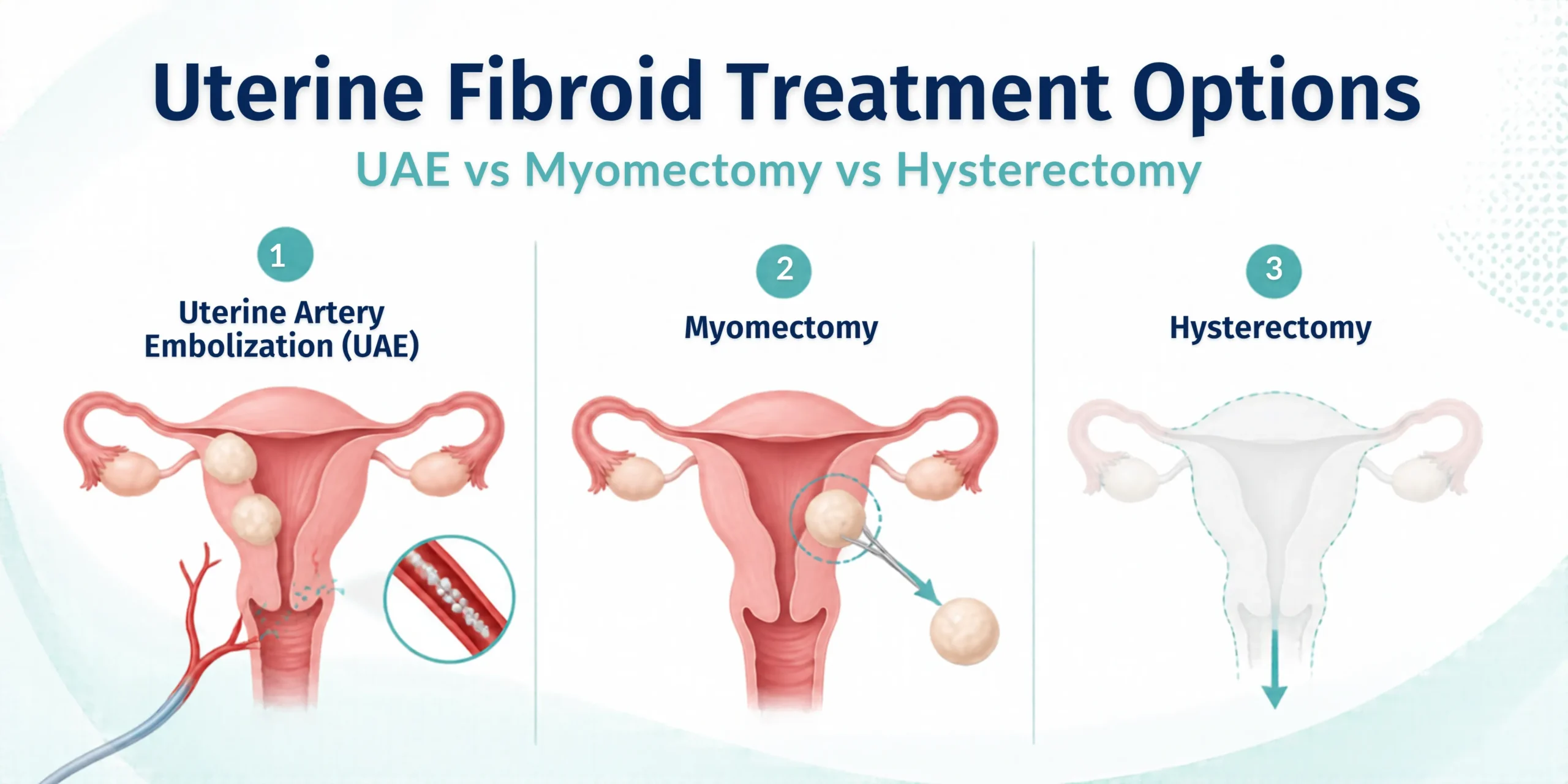
Uterine Artery Embolization vs Hysterectomy vs Myomectomy: Which Is Right for You?
When fibroids need treatment, three names come up again and again: hysterectomy, myomectomy and uterine artery embolization (UAE). They all treat fibroids, but in very different ways, with different recovery times, risks and effects on your future. If you are comparing uterine artery embolization vs hysterectomy, or weighing embolization against myomectomy, this guide lays out the differences honestly so you can have a clearer conversation with your doctor.
It is written by the team at Vikash IR Clinic in Bengaluru, where Dr. Vikash Chennur, an interventional radiologist, performs uterine artery embolization treatment in Bangalore. We will tell you where UAE shines and where the other options may be better, because the right answer depends on you.
The Short Answer
- Choose UAE if you want to keep your uterus, avoid general anaesthesia and major surgery, and get back to normal life sooner, and you are not planning a pregnancy in the near future.
- Choose myomectomy if preserving fertility is your main priority, or you have a few specific fibroids that a surgeon can remove.
- Choose hysterectomy if you are certain you do not want more children and want a permanent solution that removes the possibility of fibroids returning.
Now the details.
Quick Comparison Table
| Uterine Artery Embolization | Myomectomy | Hysterectomy | |
| What it does | Blocks blood supply so fibroids shrink | Surgically removes the fibroids | Removes the uterus |
| Approach | Catheter through a pinhole in wrist or groin | Open, laparoscopic or hysteroscopic surgery | Open, laparoscopic or vaginal surgery |
| Anaesthesia | Local with sedation | General | General |
| Uterus preserved | Yes | Yes | No |
| Hospital stay | Usually about a day | Moderate | Longest |
| Recovery | Usually fastest | Moderate | Slowest |
| Handles multiple fibroids | Yes, treated together | Depends on number and size | Yes (uterus removed) |
| Fibroids can return | New fibroids can develop; treated ones usually do not regrow fully | New fibroids can develop | No |
| Future pregnancy | Possible but less predictable | Often preferred when fertility matters | Not possible |
| Chance of needing more treatment | Higher than myomectomy | Lower | Lowest |
Uterine Artery Embolization (UAE)
How it works
An interventional radiologist passes a thin catheter, through a pinhole puncture in the wrist or groin, to the uterine arteries under live X-ray guidance. Tiny particles are released to block the vessels that feed the fibroids. Starved of blood, the fibroids shrink and soften over the following months, and symptoms such as heavy bleeding and pelvic pressure improve.
Advantages
- No surgical incision and no scar on the abdomen
- Uterus preserved
- All fibroids are treated in one sitting
- No general anaesthesia in most patients
- Short hospital stay, often one day
- Faster return to normal activities than after surgery
Limitations
- Cramping, fever and fatigue for a few days (post-embolization syndrome)
- Results appear gradually over weeks to months
- A higher chance of needing further treatment than after myomectomy
- Less predictable effect on future pregnancy
- Not suitable for every fibroid type or position
For the full procedure, recovery and cost factors, see our page on uterine fibroid embolization in Bangalore.
Myomectomy
How it works
The surgeon removes the fibroids but leaves the uterus in place. It can be done as open abdominal surgery, laparoscopically (keyhole), or through the cervix with a hysteroscope for fibroids inside the uterine cavity.
Advantages
- The fibroids are physically removed
- Often the preferred option when a woman wants to conceive
- Can give excellent symptom relief
Limitations
- Major surgery with general anaesthesia
- More blood loss than UAE, and a longer recovery than embolization
- Scarring on the uterus, which matters for future deliveries
- New fibroids can grow later
Hysterectomy
How it works
The uterus is removed, either through an abdominal cut, through keyhole ports or through the vagina. Sometimes the ovaries are removed too, which has hormonal consequences.
Advantages
- A permanent solution: fibroids cannot return, and periods stop
- Very reliable relief of fibroid symptoms
Limitations
- The biggest surgery of the three, with the longest recovery
- Pregnancy is no longer possible
- Risks include bleeding, infection and injury to nearby organs. Long-term effects such as pelvic floor problems can occur in some women
- Some women experience emotional or hormonal changes, particularly if the ovaries are also removed
What Does the Research Say?
Marketing pages often skip this part, so here it is in plain language.
UAE versus hysterectomy. Studies comparing the two show that UAE involves a much shorter hospital stay and a quicker return to everyday activities. In one large American analysis, women who had hysterectomy stayed in hospital about five days on average compared with about one day after UAE, and needed blood transfusions more often. The trade-off is that after hysterectomy there is no chance of fibroids returning, while a share of women who have UAE go on to need more treatment.
UAE versus myomectomy. Evidence reviews find that both are effective for symptomatic fibroids. UAE shortens the procedure, the hospital stay and the time to resume routine activities, and carries a lower rate of early complications. However, UAE has a higher rate of reintervention, and in the UK FEMME randomised trial, women who had myomectomy reported somewhat better quality of life than those who had UAE, although complication rates were similar. Long-term estimates suggest that roughly one in five women need some further procedure after myomectomy over five years, and about one in four after UAE.
Pregnancy. In large database studies, more women conceived after myomectomy than after UAE, though these studies cannot account for differences in age and intent to conceive. The safe takeaway is that when pregnancy is your main goal, myomectomy is usually the first option to discuss, and UAE should be considered more carefully.
These findings do not make UAE a poor choice. They mean it is a strong choice for the right patient, and the right patient is one who values keeping her uterus and recovering quickly, and who understands that a minority of women need more treatment later.
How to Choose: Which Option Fits Your Situation?
| Your situation | Option usually considered first |
| You want to keep your uterus and avoid open surgery | UAE |
| You are planning a pregnancy in the near future | Myomectomy |
| You have multiple fibroids throughout the uterus | UAE (or hysterectomy if finished with childbearing) |
| You are close to menopause and want the least disruption | UAE |
| You have other health conditions that make surgery risky | UAE |
| You are sure you want no more children and want a permanent cure | Hysterectomy |
| You have a single large fibroid or a fibroid inside the uterine cavity | Myomectomy (hysteroscopic if inside the cavity) |
| Fibroid is suspected to be cancer, or you have other uterine disease | Surgery, after specialist evaluation |
This table is only a starting point. Your own scans, symptoms and plans decide the answer.
Five Questions to Ask Yourself
- Do I want to have children in future? If yes, speak to a fertility-aware gynaecologist about myomectomy and discuss UAE carefully.
- How important is it to keep my uterus? Many women feel strongly about this, and UAE and myomectomy both preserve it.
- How quickly do I need to be back at work or caring for my family? UAE usually has the shortest recovery.
- How do I feel about general anaesthesia and major surgery? UAE avoids both in most cases.
- What do my scans show? The size, number and position of fibroids can make one option clearly better than another.
Do Not Skip the MRI
A pelvic MRI is one of the most useful tests before choosing a treatment. It shows the exact number, size and type of your fibroids, helps distinguish fibroids from adenomyosis, and shows whether UAE is likely to work. Ask for one before you agree to any fibroid surgery.
Is a Second Opinion Worth It?
Many women are told that hysterectomy is the only option, without hearing about embolization. If you have been advised hysterectomy or surgery and have not yet been told about UAE, getting a second opinion from an interventional radiologist costs little and can show whether a minimally invasive option is open to you.
Cost: How Do the Three Compare?
Costs vary with the hospital, room category, number and size of fibroids and insurance. UAE usually involves a shorter stay and less time off work, which can offset a higher procedure cost, while surgery carries longer hospital and recovery costs. For a personal estimate, see the information on uterine artery embolization cost in Bangalore or contact the clinic after your reports are reviewed.
Frequently Asked Questions
Is uterine artery embolization better than hysterectomy?
Neither is better for everyone. UAE keeps your uterus and offers a faster recovery, while hysterectomy is a permanent solution that removes any chance of fibroids returning. The right choice depends on your age, symptoms, scans and whether you want to preserve your uterus.
Is UAE better than myomectomy?
UAE is less invasive and recovery is quicker, but myomectomy has a lower chance of needing repeat treatment and is generally preferred when pregnancy is the main goal.
Can fibroids come back after embolization?
Fibroids that were embolized usually do not regrow fully, but new fibroids can develop and some women need further treatment. Regular follow-up is important.
Will I go through early menopause after UAE?
Most women do not, but there is a small chance of changes in ovarian function, which is higher in women near menopause. Your doctor will discuss this with you.
Can I get pregnant after UAE?
Pregnancies after UAE have been reported, but evidence is more limited than for myomectomy, so women hoping to conceive soon should discuss their options carefully before choosing.
How long is recovery after each procedure?
UAE: many women resume routine activities in about one to two weeks. Myomectomy and hysterectomy usually need longer, depending on whether surgery is open or keyhole.
How do I know which option is right for me?
A consultation with your MRI or ultrasound reports reviewed by an interventional radiologist and your gynaecologist is the most reliable way to decide.
Get a Second Opinion in Bangalore
If you have been advised hysterectomy or surgery and want to explore alternatives, Dr. Vikash Chennur can review your scans and explain your options clearly, including when surgery is the better choice. Read more about uterine artery embolization treatment in Bangalore, or read our guide on fibroid treatment without surgery.
Vikash IR Clinic Docube, 1st Floor, 15, Bannerghatta Rd, 3rd Phase, J.P. Nagar, Bengaluru
Phone / WhatsApp: +91 96320 74646
Disclaimer: This article is for general information and does not replace medical advice. Please consult a qualified doctor about your own situation.
References
- Gupta JK et al. Uterine artery embolization for symptomatic uterine fibroids. Cochrane Database of Systematic Reviews, 2014.
- Manyonda I et al. Uterine artery embolisation versus myomectomy for premenopausal women with uterine fibroids wishing to avoid hysterectomy: the FEMME randomised controlled trial. NIHR Health Technology Assessment, 2022.
- Davis MR et al. Reintervention rates after myomectomy, endometrial ablation and uterine artery embolization for patients with uterine fibroids. Journal of Women’s Health, 2018.
- Deipolyi AR et al. Hysterectomy and myomectomy versus uterine artery embolization for symptomatic fibroids and adenomyosis: national and regional trends and adverse events. Journal of Vascular and Interventional Radiology, 2025.
- de Bruijn AM et al. Uterine artery embolization vs hysterectomy in the treatment of symptomatic uterine fibroids: 10-year outcomes from the randomized EMMY trial. American Journal of Obstetrics and Gynecology, 2016.