
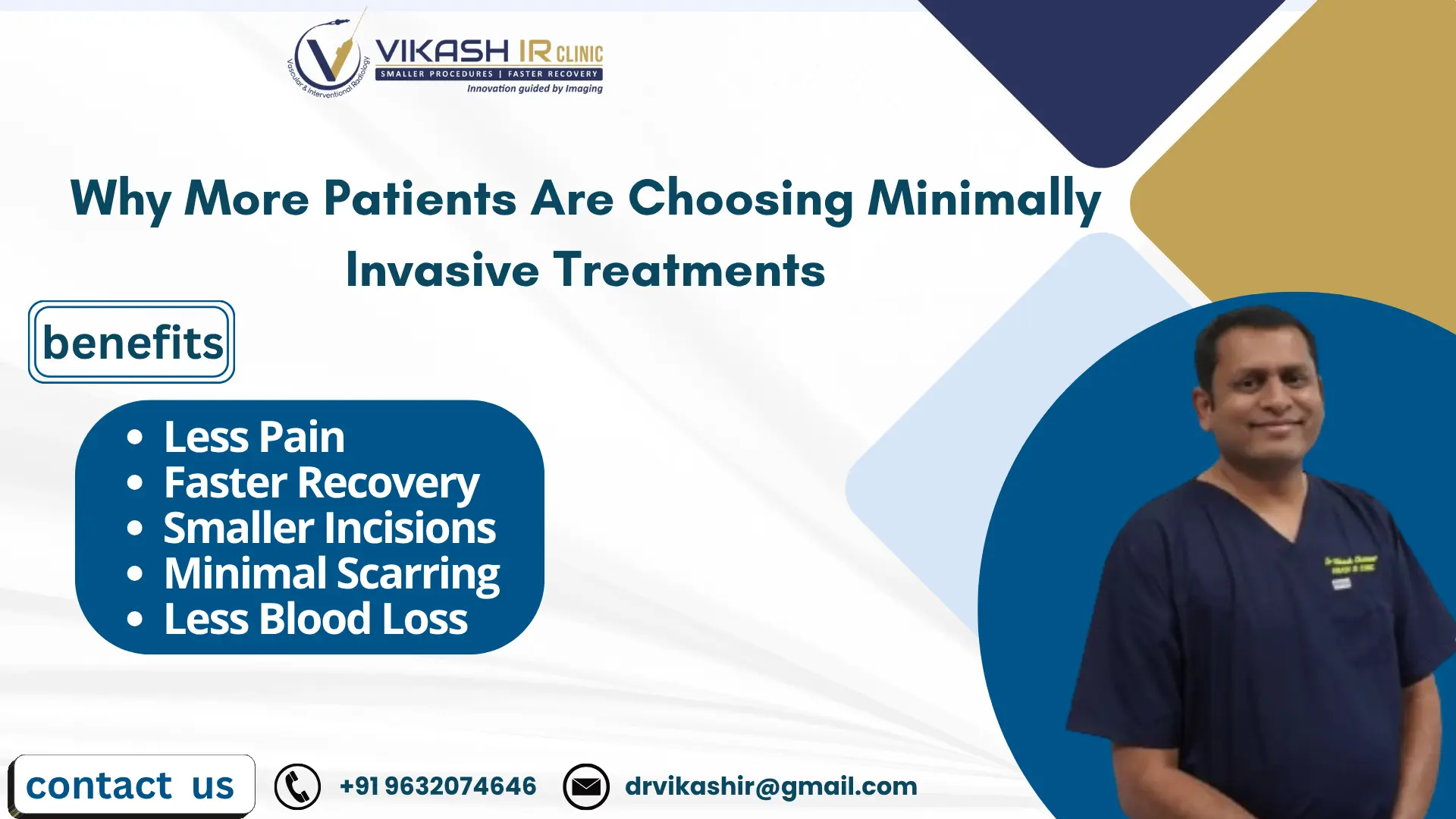
Patients today are increasingly looking for medical treatments that can address their condition effectively while causing less disruption to the body. Advances in image-guided medicine have made it possible to treat many conditions through tiny punctures, needles, or catheters rather than large surgical incisions. This has made Non-Surgical Treatment Options an important part of modern healthcare.
Get Expert Varicocele Treatment Guidance — Book Your Consultation or WhatsApp Us Today.
Why Choose Minimally Invasive Treatments? The answer depends on the medical condition, the patient’s overall health, the available treatment options, and the expertise of the treating specialist. Minimally invasive procedures are not appropriate for every patient, but when suitable, they may offer advantages such as smaller incisions, less tissue trauma, shorter hospital stays, and faster recovery.
Interventional radiology is one of the specialties at the forefront of this approach. It uses imaging such as ultrasound, CT, MRI, and fluoroscopy to guide small instruments precisely to the area being treated. AIIMS describes interventional radiology as a specialty in which minimally invasive procedures are performed using image guidance, including procedures involving needles and small catheters.
For patients considering alternatives to conventional surgery, understanding Why Choose Minimally Invasive Treatments? can help them have a more informed discussion with their doctor.
Understanding Minimally Invasive Treatments
Why Choose Minimally Invasive Treatments? One major reason is that these procedures can sometimes achieve the desired therapeutic goal without the extensive tissue disruption associated with open surgery.
Unlike traditional operations that may require a relatively large incision, Minimally Invasive Surgery and image-guided interventions generally use small access points. Depending on the procedure, a doctor may insert a catheter through a blood vessel or use a fine needle to reach a specific area.
This approach is particularly useful in interventional radiology, where real-time imaging helps the specialist navigate instruments accurately. Treatments can include embolization, ablation, vascular procedures, drainage procedures, and other targeted interventions.
Common conditions treated with minimally invasive approaches
The appropriate treatment depends on the diagnosis, but minimally invasive procedures may be considered for conditions such as:
- Uterine fibroids
- Varicose veins
- Thyroid nodules
- Enlarged prostate
- Varicocele
- Certain liver tumors
- Some vascular conditions
- Selected musculoskeletal conditions
- Certain pain conditions
- Fibroadenoma and selected breast lesions
For example, uterine fibroid embolization can reduce blood flow to fibroids, while prostate artery embolization may be considered for selected patients with enlarged prostate. Tumor ablation and transarterial therapies are also used in appropriately selected cancer patients.
Symptoms and causes
Minimally invasive treatment is not a diagnosis itself. Patients first need to understand what is causing their symptoms.
Symptoms vary significantly depending on the condition. Fibroids may cause heavy menstrual bleeding or pelvic pressure. Varicose veins can cause leg heaviness, swelling, aching, or visible enlarged veins. An enlarged prostate may result in urinary frequency, weak urine flow, or difficulty emptying the bladder. Thyroid nodules may be discovered incidentally or may cause pressure or swallowing-related symptoms when sufficiently large.
The underlying causes are also different. Fibroids develop from uterine muscle and connective tissue; varicose veins are associated with impaired venous valve function; benign prostate enlargement is associated with age-related changes; and thyroid nodules can have several causes.
Therefore, patients should not select a procedure simply because it is described as “non-surgical.” The correct treatment should be based on an appropriate medical evaluation.
Diagnosis
Diagnosis usually begins with a medical history and physical examination. Depending on the suspected condition, doctors may recommend blood tests, ultrasound, CT, MRI, Doppler studies, biopsy, or other investigations.
Imaging is particularly important in interventional radiology because it helps the specialist identify the treatment target and plan the safest access route.
Why Choose Minimally Invasive Treatments? Because modern imaging allows doctors to combine diagnosis and targeted treatment in carefully selected cases. However, the benefits and suitability differ from one patient to another.
Treatment, Benefits and Recovery
Why Choose Minimally Invasive Treatments? For many eligible patients, the attraction is the possibility of achieving treatment with less physical disruption than conventional surgery.
The exact procedure depends on the condition.
How minimally invasive procedures work
A typical image-guided procedure may involve:
- Reviewing scans and medical history before treatment.
- Preparing and sterilizing the treatment area.
- Providing local anesthesia and, when appropriate, sedation.
- Making a very small skin puncture.
- Introducing a needle or catheter under imaging guidance.
- Delivering the intended treatment.
- Removing the instrument and closing the small access site.
- Monitoring the patient during recovery.
For embolization, for example, a catheter may be guided through a blood vessel to deliver tiny particles or other’ embolic material to a targeted blood supply. For ablation, specialized energy may be used to destroy selected abnormal tissue. The exact technique, anesthesia, duration, and follow-up depend on the condition and individual patient.
Benefits
Potential benefits of appropriate minimally invasive procedures can include:
- Smaller access points
- Less tissue trauma
- Reduced scarring in many procedures
- Less postoperative discomfort in some cases
- Shorter hospital stays for many procedures
- Earlier return to normal activities
- Reduced need for prolonged bed rest
- Targeted treatment of specific tissues
- Possibility of avoiding major surgery in selected patients
These benefits should not be interpreted as a guarantee. Every medical procedure has potential risks, and some patients may still require conventional surgery.
The concept behind Non-Surgical Treatment Options is not simply to avoid an operation at any cost. Instead, the objective is to identify a treatment that provides an appropriate balance between effectiveness, safety, recovery, and the patient’s individual goals.
Recovery
Recovery varies according to the procedure and the patient’s health.
Some image-guided interventions can be performed as day-care procedures, while others may require overnight observation. Patients may experience temporary soreness, bruising, fatigue, or other procedure-specific symptoms.
Doctors typically provide instructions regarding wound care, medications, physical activity, diet, and follow-up appointments. Patients should follow these instructions carefully and contact their healthcare team if they develop concerning symptoms such as severe or worsening pain, significant bleeding, fever, difficulty breathing, or other unexpected problems.
Why Choose Minimally Invasive Treatments? Faster recovery can be an important consideration, particularly for patients who want to return to work and normal activities sooner, but recovery should never be the only factor used to select a treatment.
Minimally invasive treatment vs traditional surgery
| Feature | Minimally invasive approach | Traditional surgery |
| Access | Small puncture/incision in many procedures | Larger incision may be required |
| Tissue disruption | Usually limited | May be greater |
| Scarring | Often minimal | May be more noticeable |
| Hospital stay | Often shorter, depending on procedure | May be longer |
| Recovery | Often quicker for suitable procedures | Can require longer recovery |
| Suitability | Depends on condition and anatomy | May be necessary for certain conditions |
| Anesthesia | Local anesthesia/sedation may be sufficient for some procedures | General anesthesia is commonly used for many major operations |
This comparison is general. A minimally invasive procedure is not automatically safer or more effective than surgery for every disease. In some situations, conventional surgery remains the most appropriate treatment.
Why Choose Minimally Invasive Treatments? — Doctor, Services & FAQs
Why Choose Minimally Invasive Treatments? For patients who may qualify, the combination of targeted treatment, advanced imaging, and potentially shorter recovery can make these approaches an attractive alternative to selected conventional procedures.
About Dr. Vikash Chennur
Dr. Vikash Chennur is an experienced interventional radiologist in Bengaluru with qualifications including MBBS, MD in Radio Diagnosis/Radiology, and DNB in Radio Diagnosis. Publicly available professional information states that he has more than 18 years of specialist experience and has trained and worked across India, Canada, and Australia. He is also described as an AIIMS New Delhi Gold Medalist.
His practice focuses on image-guided, minimally invasive care and individualized treatment planning. His listed areas of expertise include uterine fibroid embolization, thyroid nodule ablation, thyroid artery embolization, varicocele embolization, prostate artery embolization, varicose vein treatment, fibroadenoma treatment, interventional pain management, image-guided tumor ablation,liver cancer ablation, TACE, hepatobiliary and portal hypertension interventions, genicular artery embolization, and other interventional radiology procedures.
The doctor’s clinic is listed at Vikash IR Clinic, Docube, 1st Floor, 15, Bannerghatta Road, 3rd Phase, J.P. Nagar, Bengaluru.
Key services
Uterine Fibroid Embolization (UFE): A minimally invasive treatment that blocks selected blood vessels supplying fibroids, helping them shrink over time.
Thyroid Nodule Ablation: Image-guided ablation can be considered for appropriately selected benign thyroid nodules and may avoid an open neck operation.
Prostate Artery Embolization (PAE): A catheter-based procedure that may be suitable for selected men with symptomatic benign prostate enlargement.
Varicose Vein Treatment: Endovenous and other minimally invasive approaches can treat problematic veins without traditional vein-stripping surgery in appropriate cases.
Varicocele Embolization: A catheter-based approach used for selected patients with symptomatic varicocele.
Liver Tumor Ablation and TACE: Image-guided tumor treatments may be used in selected patients with liver tumors and other oncological conditions.
Fibroadenoma Treatment: Selected benign breast lumps may be treated through minimally invasive techniques designed to preserve surrounding breast tissue.
Interventional Pain Management: Image-guided procedures may be considered for certain chronic pain conditions after appropriate evaluation.
Frequently Asked Questions
1. What are Non-Surgical Treatment Options?
Non-Surgical Treatment Options are treatments that manage or treat a condition without conventional open surgery. They can include medications, image-guided interventions, ablation, embolization, and other therapies depending on the disease.
2. Is minimally invasive treatment suitable for everyone?
No. Suitability depends on the diagnosis, anatomy, severity of disease, previous treatments, overall health, and available evidence. A specialist should determine whether a procedure is appropriate.
3. Is Minimally Invasive Surgery safer than open surgery?
It can have advantages for selected patients, including smaller access points and potentially shorter recovery. However, every procedure has risks, and safety depends on the specific treatment and patient.
4. Will minimally invasive procedures leave scars?
Many procedures use very small punctures, so visible scarring may be minimal. The final appearance depends on the procedure, access site, healing, and individual factors.
5. How long does recovery take?
Recovery varies considerably. Some procedures allow patients to return home the same day, while others require observation or a longer recovery period. Your doctor can provide a procedure-specific recovery plan.
6. Can fibroids be treated without major surgery?
Yes. Uterine fibroid embolization is one established minimally invasive treatment option for appropriately selected patients with symptomatic fibroids.
7. Can an enlarged prostate be treated without surgery?
Selected patients with benign prostate enlargement may be candidates for prostate artery embolization. A detailed evaluation is required before deciding whether PAE is appropriate.
8. Are minimally invasive procedures painful?
Many procedures involve local anesthesia, sedation, or other pain-control measures. Some temporary discomfort can occur during recovery, and the level of discomfort depends on the specific procedure.
9. Why is image guidance important?
Image guidance allows the interventional radiologist to visualize anatomy and guide needles or catheters toward the intended treatment area. This supports precise, targeted intervention.
Conclusion
Why Choose Minimally Invasive Treatments? Because modern medicine can sometimes treat conditions effectively while reducing the physical impact associated with major surgery. Smaller access points, targeted therapy, potentially shorter hospital stays, and faster recovery make these procedures valuable options for appropriately selected patients.
At the same time, Minimally Invasive Surgery and interventional procedures should never be chosen simply because they sound easier. The right treatment depends on an accurate diagnosis, evidence-based decision-making, patient preferences, and specialist assessment.
If you are exploring Non-Surgical Treatment Options for fibroids, thyroid nodules, varicose veins, varicocele, enlarged prostate, liver tumors, fibroadenoma, or other conditions, an experienced interventional radiologist can help you understand whether a minimally invasive approach is appropriate.
Book an Appointment with Dr. Vikash Chennur
If you are considering an alternative to conventional surgery, consult Dr. Vikash Chennur | AIIMS Gold Medalist | Best Endovascular Interventional Radiologist in Bengaluru for an individualized evaluation. His practice provides a range of image-guided and minimally invasive interventional radiology treatments, with an emphasis on precise procedures and patient-centered decision-making.
Book your consultation today and discuss whether a minimally invasive or non-surgical treatment approach may be right for you.
Why Choose Minimally Invasive Treatments? Start with the right diagnosis, understand all available options, and make your treatment decision with an experienced specialist.
For more information or to schedule a consultation, visit Vikash IR Clinic, Docube, 1st Floor, 15, Bannerghatta Road, 3rd Phase, J.P. Nagar, Bengaluru.and take the first step Discussing your Treatment.